Introduction
Definition
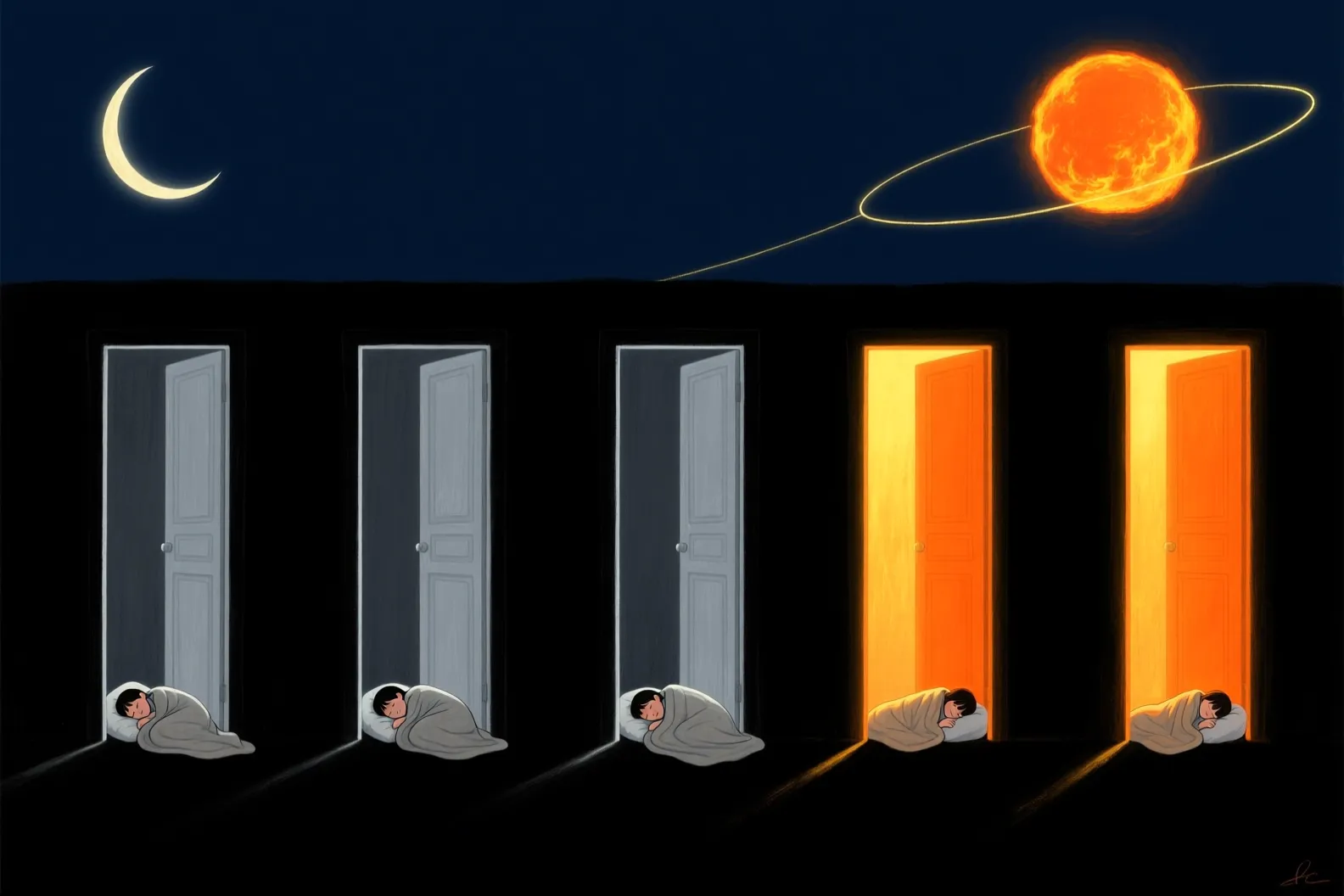
Social jetlag is the gap between the timing of sleep on workdays or school days and its timing on free days. It reflects a mismatch between the internal biological clock and the social clock that work, school and other obligations set.1 Researchers express social jetlag in hours, usually as the difference between the midpoint of sleep on free days and the midpoint of sleep on workdays.1,2 The name draws an analogy with the jet lag that follows travel across time zones. A person with social jetlag, however, shifts the timing of sleep each week without leaving home.1
Context
Researchers in Munich introduced the term in 2006, using data from the Munich ChronoType Questionnaire (MCTQ).1,3 Late chronotypes, people whose clocks favor late sleep, show the largest gap, because early work and school times cut their sleep short during the week.1 Since then, surveys and cohort studies have linked social jetlag with obesity, metabolic risk and depressive symptoms, although nearly all of this evidence comes from observational studies.4,5,6
Scope
This entry covers the definition and measurement of social jetlag, its causes and variation, the evidence on health, its management and the main open debates. The entry on circadian rhythm describes the internal clock itself.
Detailed Explanation
Components
Three quantities define social jetlag: chronotype, the timing of sleep on workdays, and the timing of sleep on free days.2 Chronotype describes the timing that a person’s circadian clock favors, and genetic background, age, sex and environmental light exposure all shape it.4 The MCTQ estimates chronotype from the midpoint of sleep on free days, because on those days no alarm clock ends sleep.2,3 However, people who sleep too little during the week tend to sleep longer on free days. For this reason, the questionnaire corrects the free-day midpoint for this catch-up sleep.2,3
The standard formula subtracts the midpoint of sleep on workdays from the midpoint of sleep on free days.1,2 Take, for example, a person who sleeps from 23:00 to 06:30 on workdays, so that the midpoint of sleep falls at 02:45. If the same person sleeps from 01:00 to 09:30 on free days, the midpoint moves to 05:15, so social jetlag equals 2.5 hours. Most studies report the absolute value of this difference.7 Some studies keep the sign instead, since a few people sleep earlier on free days than on workdays.8 Researchers also tend to sort people into three bands: less than 1 hour, 1 to 2 hours, and more than 2 hours of social jetlag.7,9,10
Critics argue that the standard formula mixes two things, circadian misalignment and sleep debt.11 When a late chronotype wakes to an alarm on workdays and then sleeps in on free days, the wake time moves more than the bedtime. Part of the shift in the midpoint therefore reflects recovery sleep rather than a later clock.11 A sleep-corrected formula addresses this problem: for people who sleep longer and fall asleep later on free days, it compares sleep onset on free days with sleep onset on workdays.11 In the example above, the sleep-corrected value is 2.0 hours rather than 2.5 hours. Because studies differ in the formula they apply, their results do not always compare well.2,11
The data behind these formulas come from two main sources. Questionnaires such as the MCTQ ask about usual sleep times on workdays and free days separately.3 Wrist-worn activity monitors, a method called actigraphy, record movement over several days and estimate sleep from it. One study of 447 working adults, for example, took the midpoints of sleep from actigraphy on nights before workdays and before free days.12 Similarly, a study of 804 adolescents required at least 5 days of wrist actigraphy.13 Studies of children have also relied on wrist accelerometers.14 The online MCTQ alone gathered almost 300,000 entries from around the world, and the questionnaire now exists in 13 languages.2 Self-reports capture habits across many weeks, while devices give objective times but cover only a short window.
| Term | Definition | How it is derived |
|---|---|---|
| Chronotype | The timing of sleep that a person’s circadian clock favors | Midpoint of sleep on free days, corrected for catch-up sleep |
| Midpoint of sleep, workdays | Halfway point between sleep onset and waking on workdays | Questionnaire, diary or actigraphy |
| Midpoint of sleep, free days | Halfway point between sleep onset and waking on free days | Questionnaire, diary or actigraphy |
| Social jetlag (standard) | Free-day midpoint minus workday midpoint, usually as an absolute value | Calculated in hours |
| Social jetlag (sleep-corrected) | Difference in sleep onset, or in waking, between free days and workdays | Calculated in hours; removes most of the sleep-debt component |
| Relative social jetlag | The standard value with its sign kept | Negative when sleep comes earlier on free days |
Variations in Social Jetlag
Chronotype drives much of the variation in social jetlag. Late types show the largest differences between workdays and free days, and they build up the largest sleep debt during the week.1 Extreme early types, in contrast, show little difference between the two kinds of day.3 Some people even sleep earlier on free days. In a study of 452 university students, signed social jetlag ranged from minus 3 hours to almost 8 hours.8
Age also matters, because chronotype grows later through adolescence, reaches its latest point near the end of adolescence, and then grows earlier again with age.15,16 As a result, social jetlag runs highest in teenagers and young adults, who face early school and university schedules.1,15 Among the 452 students, for instance, the mean social jetlag was 2 hours 23 minutes, and 63.7% had 2 hours or more.8 Working adults typically show smaller values; among 1,404 Japanese employees, 63.5% had less than 1 hour, 28.4% had 1 to 2 hours, and 8.1% had at least 2 hours.7 Social jetlag also appears in children as young as 8 to 10 years.17 Differences between the sexes appear too: in 276 New Zealand adolescents, boys had 25.1 minutes more social jetlag than girls.18
Light exposure shapes social jetlag through its effect on the clock. In a survey of 500 people, more time outdoors in daylight correlated with earlier sleep.3 Modern indoor life, by comparison, provides little daylight and much electric light at night, which pushes the clock later.19 When adults spent a summer weekend camping under natural light, their circadian and sleep timing moved earlier. That single weekend produced about 69% of the shift seen after a full week of natural light.19 Clock-time policy plays a part as well. In a survey of 55,000 people, sleep timing on free days tracked the seasonal change in dawn under standard time but not under daylight saving time.20 Moreover, the timing of activity did not adjust to the spring change of clocks, especially in late chronotypes.20 Geography contributes as well, because human sleep follows the east-west progression of dawn within a single time zone.20 Social jetlag thus reflects an interaction between individual biology and the organization of social time.1,2
Social jetlag differs from travel jet lag in two ways. Travel moves a person to a new light-dark cycle, while social jetlag shifts only the social schedule under the same sun.1 In addition, social jetlag recurs every week for years, whereas travel jet lag fades as the clock adjusts to the new time zone.1,8
Key points: social jetlag is the weekly shift in sleep timing between workdays and free days. It runs largest in late chronotypes, teenagers and young adults, and in people who get little daylight.
Scientific Basis
Physiological Mechanisms
Two processes govern sleep: a circadian clock that times sleep and wakefulness, and a homeostatic sleep pressure that builds during waking hours.16 Social time and artificial light at night move sleep later, and fixed work or school times then end it early.16 On workdays, therefore, many people wake during their biological night and accumulate a sleep debt. On free days they repay the debt and sleep at a time closer to their internal clock.1,3
This weekly swing can feed on itself. Late sleep on free days shifts light exposure later, and later light pushes the clock later still.19 A controlled trial demonstrated this effect in healthy young adults, who spent only 5 hours in bed each night through a simulated workweek. They then slept as much as they wished over a weekend.21 During the weekend, they slept about 1.1 hours more than at baseline. However, their circadian phase moved later, and insulin sensitivity in the whole body, liver and muscle fell by about 9% to 27% once short sleep resumed.21 Weekend recovery sleep, in other words, did not prevent the metabolic harm of short sleep. For background on how muscle takes up glucose, see the entry on GLUT4.
Laboratory studies of circadian misalignment offer a more extreme model. In one study, 10 adults lived on a recurring 28-hour day, so that they ate and slept at every phase of the circadian cycle.22 When behavior ran about 12 hours out of phase with the internal clock, leptin fell by 17% and glucose rose by 6%, despite 22% more insulin. The daily cortisol rhythm also reversed, and mean arterial pressure rose by 3%.22 Social jetlag produces a much smaller misalignment than this, but it recurs every week. Its weekly pattern might therefore add up to some of the same effects over years.4,5
Behavior offers a second pathway. A review of 17 studies with 28,905 participants found that people with more social jetlag followed healthy dietary patterns less closely.23 The most consistent links involved higher intakes of sugar-sweetened beverages, total fat and saturated fat.23 In 9- to 11-year-old children, those who slept late and woke late ate fruit and vegetables less often than early sleepers. They also drank sweetened beverages more often and did 9.4 fewer minutes of moderate-to-vigorous Physical Activity per day.24 Smoking also tracks late timing, and social jetlag rather than chronotype alone appears to explain much of that link.1 In 145 healthy adults, those with 2 hours or more of social jetlag had higher cortisol than those with 1 hour or less. They also slept less during the week, exercised less and had a faster resting heart rate.10
Evidence
A large epidemiological study first linked social jetlag with body mass index (BMI), beyond the effect of sleep duration.4 A cohort study then tested the idea with clinical measures. In 815 non-shift workers from the population-based Dunedin Study in New Zealand, social jetlag correlated with many clinically measured markers of metabolic dysfunction and obesity.5 Among obese participants, those who were metabolically unhealthy had more social jetlag than those who were metabolically healthy. In that unhealthy group, social jetlag also correlated with higher glycated hemoglobin (HbA1c) and a marker of inflammation.5 The SciencEye entry on systemic inflammation explains that marker’s role.
Studies with objective sleep data support these findings. In 447 healthy midlife adults on day shifts, actigraphy-based social jetlag correlated with lower high-density lipoprotein (HDL) cholesterol, higher triglycerides, higher fasting insulin, insulin resistance and greater adiposity.12 These links held after adjustment for sleep quality, sleep duration, depressive symptoms and health behaviors.12 In the New Hoorn Study of 1,585 adults in the Netherlands, social jetlag of more than 2 hours correlated with metabolic syndrome. The link, however, applied only to participants younger than 61.9 In that younger group, the prevalence ratios for more than 2 hours of social jetlag were 2.13 for metabolic syndrome and 1.75 for diabetes or prediabetes.9
Children and adolescents show similar patterns. In 341 children aged 8 to 10, social jetlag correlated with all five adiposity measures, while sleep duration correlated with none.17 Each extra hour of social jetlag matched about 3% more body fat.17 In 381 children aged 9 to 11, social jetlag predicted BMI z-score after adjustment, with a clear effect in girls but not in boys.14 Similarly, in 804 adolescents in the United States, each hour of social jetlag correlated with a 1.19 cm larger waist in girls. Each hour also correlated with a higher fat mass index in girls, while boys showed no such links.13 Beyond body fat, social jetlag showed associations with vascular health and cholesterol in 332 children aged 8 to 10.25 In 276 adolescents, each hour of social jetlag matched 0.72 ml/kg/min lower cardiorespiratory fitness, with the effect confined to boys.18
Mental health forms a second strand of evidence. In a rural population of 4,051 people, depression scores ran higher in people with more than 2 hours of social jetlag.6 Among Japanese non-shift workers, 2 hours or more of social jetlag doubled the odds of depressive symptoms, with an odds ratio of 2.14.7 A review also links late sleep timing and social jetlag with poorer cognitive performance and with psychiatric disorders.16
| Study | Population | Main finding |
|---|---|---|
| Wittmann and colleagues, 2006 | 501 volunteers | Introduced social jetlag; linked it with smoking and wellbeing |
| Parsons and colleagues, 2015 | 815 non-shift workers, New Zealand | Social jetlag linked with clinical markers of metabolic dysfunction |
| Wong and colleagues, 2015 | 447 midlife workers, United States | Actigraphy-based social jetlag linked with lipids, insulin and adiposity |
| Koopman and colleagues, 2017 | 1,585 adults, the Netherlands | Over 2 hours linked with metabolic syndrome in adults under 61 |
| Stoner and colleagues, 2018 | 341 children aged 8 to 10, New Zealand | Each hour linked with about 3% more body fat |
| Depner and colleagues, 2019 | Controlled trial in young adults, United States | Weekend catch-up sleep delayed the clock and did not prevent loss of insulin sensitivity |
| Arab and colleagues, 2024 | 43 studies, 231,648 participants | Meta-Analysis: consistent but small links with adiposity |
Current Understanding
Two meta-analyses summarize the metabolic evidence. The first pooled 43 studies with 231,648 participants and found that social jetlag correlated with BMI, fat mass, body fat percentage and waist circumference.26 Its correlation with BMI was small, at 0.12, and the odds of overweight or obesity rose by about 20%.26 The second pooled 68 studies. In high-quality studies, social jetlag correlated with 0.49 kg/m² higher BMI, 1.11 cm larger waist circumference and 0.42% higher HbA1c.27 However, it showed no significant link with obesity as a category, metabolic syndrome or type 2 diabetes.27 Readers can see how such pooled estimates work in the entry on meta-analysis.
Researchers therefore broadly agree that social jetlag is common and that it shows small but consistent associations with adiposity. Its associations with diabetes, metabolic syndrome and mental health remain less certain.27,28 Controlled studies of circadian misalignment and weekend catch-up sleep make a causal role plausible.21,22 Yet no long-term trial has shown that reducing social jetlag improves health.
Clinical and Practical Applications
Relevance
Social jetlag matters in practice for three reasons. First, it is easy to measure from two pairs of sleep times, so clinicians and researchers can screen large groups quickly.2 Second, it predicts adiposity and cardiometabolic markers beyond sleep duration, especially in children.14,17,25 Several pediatric studies therefore name social jetlag as a measurable public health target.17,25 In adolescents, it also predicts lower cardiorespiratory fitness in boys, and fitness itself is a vital sign that improves the classification of health risk.18 Because the main adult cohorts studied day workers rather than shift workers, these findings apply to people on ordinary daytime schedules.5,12 Third, its links with blood pressure and HbA1c tie it to the same risk factors that clinicians already track in adults.27 For related measures of arterial health, see pulse wave velocity, and for treatment of glucose control, see exercise guidelines for diabetes.
Social jetlag also bears on public policy. Work schedules, school start times and daylight saving time all add to the amount of social jetlag a population carries.4,5 The researchers who coined the term argued that work and school schedules should match chronotype whenever possible.1 SciencEye also covers resting metabolic rate, a related topic in energy balance.
Measurement
Most studies measure social jetlag with the MCTQ, which asks separately about sleep on workdays and free days.2,3 Sleep diaries kept for one or more weeks give similar data with less reliance on memory.29 Actigraphy provides objective times over several days.12,13 Pediatric studies have used both wrist accelerometers and validated self-report surveys.14,18 For research on the clock itself, laboratories measure dim light melatonin onset (DLMO), the time at which melatonin starts to rise in dim light.30 This marker reflects the phase of the clock rather than sleep behavior.30 No clinical cutoff exists, although many studies flag 2 hours or more as high. Among students, that cutoff gave only 63.4% sensitivity and 35.9% specificity against the symptoms of travel jet lag.8,9 Whatever the method, the result depends on the formula, so reports should state whether they used the standard or the sleep-corrected version.11
| Method | What it gives | Strengths | Limits |
|---|---|---|---|
| Munich ChronoType Questionnaire | Usual sleep times on workdays and free days | Quick; validated; suits large surveys | Relies on recall |
| Sleep diary | Daily bedtimes and wake times | Records each night as it happens | Needs daily effort; self-reported |
| Actigraphy | Sleep estimated from wrist movement | Objective; covers several days | Short window; device cost |
| Dim light melatonin onset | Circadian phase from melatonin samples | Measures the clock itself | Laboratory or home sampling; costly |
Management
Approaches to social jetlag aim either to move the clock earlier or to move the schedule later. Light offers the main tool for the first approach, and a weekend camping under natural light moved circadian and sleep timing earlier.19 In 46 adolescents with short sleep and late bedtimes, an intervention combined bright morning light on one weekend, gradually earlier bedtimes and an evening time-management plan.30 The intervention moved bedtime 1 hour earlier in the first week and 2 hours earlier in the second. Participants also received about 6,000 lux of light for 2.5 hours on both mornings of the middle weekend.30 This group’s melatonin onset advanced by 0.6 hours, while that of the control group did not advance. By the second week, they fell asleep 1.5 hours earlier and slept 1.2 hours longer on school nights.30 SciencEye explains how evening blue light affects sleep, eyes and children.
Schedules offer the second approach. For example, when a German high school let senior students choose between an 8 am and a 9 am start each day, students slept 1.1 hours longer on later-start days.29 Their sleep onset stayed the same, their sleep quality rose and they woke less often to an alarm.29 However, total sleep across the flexible system did not exceed baseline, likely because students chose the later start too rarely.29 Even so, the students reported high satisfaction with the flexible system.29 Policy analysts also cite social jetlag in debates on daylight saving time, since the clock does not adjust to the spring change.4,20
For individuals, the evidence points to regular sleep timing across the whole week rather than catch-up sleep on weekends. Weekend recovery sleep did not protect insulin sensitivity in a controlled trial, and after-dinner energy intake and body weight rose during the weeks of short sleep.21 Observational studies also suggest that later and more variable sleep timing goes with poorer diet and less Physical Activity.23,24 Researchers have therefore proposed that programs for weight control could include steadier sleep timing, especially for girls.14,26 No randomized trial has yet tested this idea in clinical practice.26 Readers can compare medication and lifestyle approaches to diabetes.
Key points: the strongest tools against social jetlag are morning daylight, a steady sleep schedule across the week, and school or work start times that fit chronotype.
Controversies and Limitations
Debates
Researchers still debate what social jetlag measures. The standard formula blends misalignment with sleep debt, and a sleep-corrected version gives smaller values.2,11 In 452 students, social jetlag also failed to predict the symptoms of travel jet lag, which questions how far the analogy holds.8 A further debate concerns cause. Chronotype, diet and Physical Activity all track social jetlag, so any of them could explain part of its links with health.12,23,24 The MCTQ itself draws both praise for its simplicity and criticism, and its developers have published a self-critical review to clarify its definitions.2 Effect sizes form another debate. For depressive symptoms, a Meta-Analysis found a pooled correlation of only 0.049, which explains 0.24% of the variance.28 Findings also differ by population subgroup; in the New Hoorn Study, for instance, the links disappeared in adults aged 61 and over.9 Adiposity links appeared in girls but not boys, while the fitness link appeared in boys but not girls.13,14,18
| Debate | One view | Other view |
|---|---|---|
| What it measures | Misalignment between clock and schedule | Partly sleep debt and catch-up sleep |
| Cause or marker | Misalignment harms metabolism | Chronotype, diet or activity explain the links |
| Size of effect | Small effects matter across a population | Effects too small for individual prediction |
Limitations
Most studies use cross-sectional designs and self-reported sleep, and results vary widely between studies.26,27 In the obesity Meta-Analysis, for example, heterogeneity for BMI reached 95%.26 The choice of formula adds further variation.11 Future work needs longitudinal cohorts and trials that test whether lowering social jetlag improves health. Different study designs support different claims about cause.
References
- Wittmann M, Dinich J, Merrow M, Roenneberg T. Social jetlag: misalignment of biological and social time. Chronobiol Int. 2006;23(1-2):497-509. doi: 10.1080/07420520500545979
- Roenneberg T, Pilz LK, Zerbini G, Winnebeck EC. Chronotype and social jetlag: a (self-) critical review. Biology (Basel). 2019;8(3):54. doi: 10.3390/biology8030054
- Roenneberg T, Wirz-Justice A, Merrow M. Life between clocks: daily temporal patterns of human chronotypes. J Biol Rhythms. 2003;18(1):80-90. doi: 10.1177/0748730402239679
- Roenneberg T, Allebrandt KV, Merrow M, Vetter C. Social jetlag and obesity. Curr Biol. 2012;22(10):939-43. doi: 10.1016/j.cub.2012.03.038
- Parsons MJ, Moffitt TE, Gregory AM, Goldman-Mellor S, Nolan PM, Poulton R, et al. Social jetlag, obesity and metabolic disorder: investigation in a cohort study. Int J Obes (Lond). 2015;39(5):842-8. doi: 10.1038/ijo.2014.201
- Levandovski R, Dantas G, Fernandes LC, Caumo W, Torres I, Roenneberg T, et al. Depression scores associate with chronotype and social jetlag in a rural population. Chronobiol Int. 2011;28(9):771-8. doi: 10.3109/07420528.2011.602445
- Islam Z, Hu H, Akter S, Kuwahara K, Kochi T, Eguchi M, et al. Social jetlag is associated with an increased likelihood of having depressive symptoms among the Japanese working population: the Furukawa Nutrition and Health Study. Sleep. 2020;43(1):zsz204. doi: 10.1093/sleep/zsz204
- Tavares PS, Carpena MX, Carone CMM, Del-Ponte B, Santos IS, Tovo-Rodrigues L. Is social jetlag similar to travel-induced jetlag? Results of a validation study. Chronobiol Int. 2020;37(4):542-51. doi: 10.1080/07420528.2020.1712413
- Koopman ADM, Rauh SP, van 't Riet E, Groeneveld L, van der Heijden AA, Elders PJ, et al. The association between social jetlag, the metabolic syndrome, and type 2 diabetes mellitus in the general population: the New Hoorn Study. J Biol Rhythms. 2017;32(4):359-68. doi: 10.1177/0748730417713572
- Rutters F, Lemmens SG, Adam TC, Bremmer MA, Elders PJ, Nijpels G, et al. Is social jetlag associated with an adverse endocrine, behavioral, and cardiovascular risk profile? J Biol Rhythms. 2014;29(5):377-83. doi: 10.1177/0748730414550199
- Jankowski KS. Social jet lag: sleep-corrected formula. Chronobiol Int. 2017;34(4):531-5. doi: 10.1080/07420528.2017.1299162
- Wong PM, Hasler BP, Kamarck TW, Muldoon MF, Manuck SB. Social jetlag, chronotype, and cardiometabolic risk. J Clin Endocrinol Metab. 2015;100(12):4612-20. doi: 10.1210/jc.2015-2923
- Cespedes Feliciano EM, Rifas-Shiman SL, Quante M, Redline S, Oken E, Taveras EM. Chronotype, social jet lag, and cardiometabolic risk factors in early adolescence. JAMA Pediatr. 2019;173(11):1049-57. doi: 10.1001/jamapediatrics.2019.3089
- Higgins S, Stoner L, Black K, Wong JE, Quigg R, Meredith-Jones K, et al. Social jetlag is associated with obesity-related outcomes in 9-11-year-old children, independent of other sleep characteristics. Sleep Med. 2021;84:294-302. doi: 10.1016/j.sleep.2021.06.014
- Roenneberg T, Kuehnle T, Pramstaller PP, Ricken J, Havel M, Guth A, et al. A marker for the end of adolescence. Curr Biol. 2004;14(24):R1038-9. doi: 10.1016/j.cub.2004.11.039
- Taillard J, Sagaspe P, Philip P, Bioulac S. Sleep timing, chronotype and social jetlag: impact on cognitive abilities and psychiatric disorders. Biochem Pharmacol. 2021;191:114438. doi: 10.1016/j.bcp.2021.114438
- Stoner L, Castro N, Signal L, Skidmore P, Faulkner J, Lark S, et al. Sleep and adiposity in preadolescent children: the importance of social jetlag. Child Obes. 2018;14(3):158-64. doi: 10.1089/chi.2017.0272
- Higgins S, Stoner L, Lubransky A, Howe AS, Wong JE, Black K, et al. Social jetlag is associated with cardiorespiratory fitness in male but not female adolescents. Sleep Med. 2020;75:163-70. doi: 10.1016/j.sleep.2020.07.030
- Stothard ER, McHill AW, Depner CM, Birks BR, Moehlman TM, Ritchie HK, et al. Circadian entrainment to the natural light-dark cycle across seasons and the weekend. Curr Biol. 2017;27(4):508-13. doi: 10.1016/j.cub.2016.12.041
- Kantermann T, Juda M, Merrow M, Roenneberg T. The human circadian clock's seasonal adjustment is disrupted by daylight saving time. Curr Biol. 2007;17(22):1996-2000. doi: 10.1016/j.cub.2007.10.025
- Depner CM, Melanson EL, Eckel RH, Snell-Bergeon JK, Perreault L, Bergman BC, et al. Ad libitum weekend recovery sleep fails to prevent metabolic dysregulation during a repeating pattern of insufficient sleep and weekend recovery sleep. Curr Biol. 2019;29(6):957-67.e4. doi: 10.1016/j.cub.2019.01.069
- Scheer FA, Hilton MF, Mantzoros CS, Shea SA. Adverse metabolic and cardiovascular consequences of circadian misalignment. Proc Natl Acad Sci U S A. 2009;106(11):4453-8. doi: 10.1073/pnas.0808180106
- Arab A, Karimi E, Garaulet M, Scheer FAJL. Social jetlag and dietary intake: a systematic review. Sleep Med Rev. 2023;71:101820. doi: 10.1016/j.smrv.2023.101820
- Harrex HAL, Skeaff SA, Black KE, Davison BK, Haszard JJ, Meredith-Jones K, et al. Sleep timing is associated with diet and Physical Activity levels in 9-11-year-old children from Dunedin, New Zealand: the PEDALS study. J Sleep Res. 2018;27(4):e12634. doi: 10.1111/jsr.12634
- Castro N, Diana J, Blackwell J, Faulkner J, Lark S, Skidmore P, et al. Social jetlag and cardiometabolic risk in preadolescent children. Front Cardiovasc Med. 2021;8:705169. doi: 10.3389/fcvm.2021.705169
- Arab A, Karimi E, Garaulet M, Scheer FAJL. Social jetlag and obesity: a systematic review and Meta-Analysis. Obes Rev. 2024;25(3):e13664. doi: 10.1111/obr.13664
- Bouman EJ, Beulens JWJ, Groeneveld L, de Kruijk RS, Schoonmade LJ, Remmelzwaal S, et al. The association between social jetlag and parameters of metabolic syndrome and type 2 diabetes: a systematic review and Meta-Analysis. J Sleep Res. 2023;32(3):e13770. doi: 10.1111/jsr.13770
- Gao L, Gao J, Zeng Z. Social jet lag and mental health outcomes: a systematic review and Meta-Analysis. Acta Psychol (Amst). 2025;259:105419. doi: 10.1016/j.actpsy.2025.105419
- Winnebeck EC, Vuori-Brodowski MT, Biller AM, Molenda C, Fischer D, Zerbini G, et al. Later school start times in a flexible system improve teenage sleep. Sleep. 2020;43(6):zsz307. doi: 10.1093/sleep/zsz307
- Crowley SJ, Velez SL, Killen LG, Cvengros JA, Fogg LF, Eastman CI. Extending weeknight sleep of delayed adolescents using weekend morning bright light and evening time management. Sleep. 2023;46(1):zsac202. doi: 10.1093/sleep/zsac202
External Resources
- NIGMS: Circadian Rhythms: a fact sheet on the body clock from the US National Institute of General Medical Sciences.
- NHLBI: Sleep Deprivation and Deficiency: causes, health effects and treatment of insufficient sleep from the US National Heart, Lung, and Blood Institute.
- CDC: About Sleep: sleep guidance from the US Centers for Disease Control and Prevention.
- PubMed: social jetlag: the current research literature from the US National Library of Medicine.


Leave a Reply