
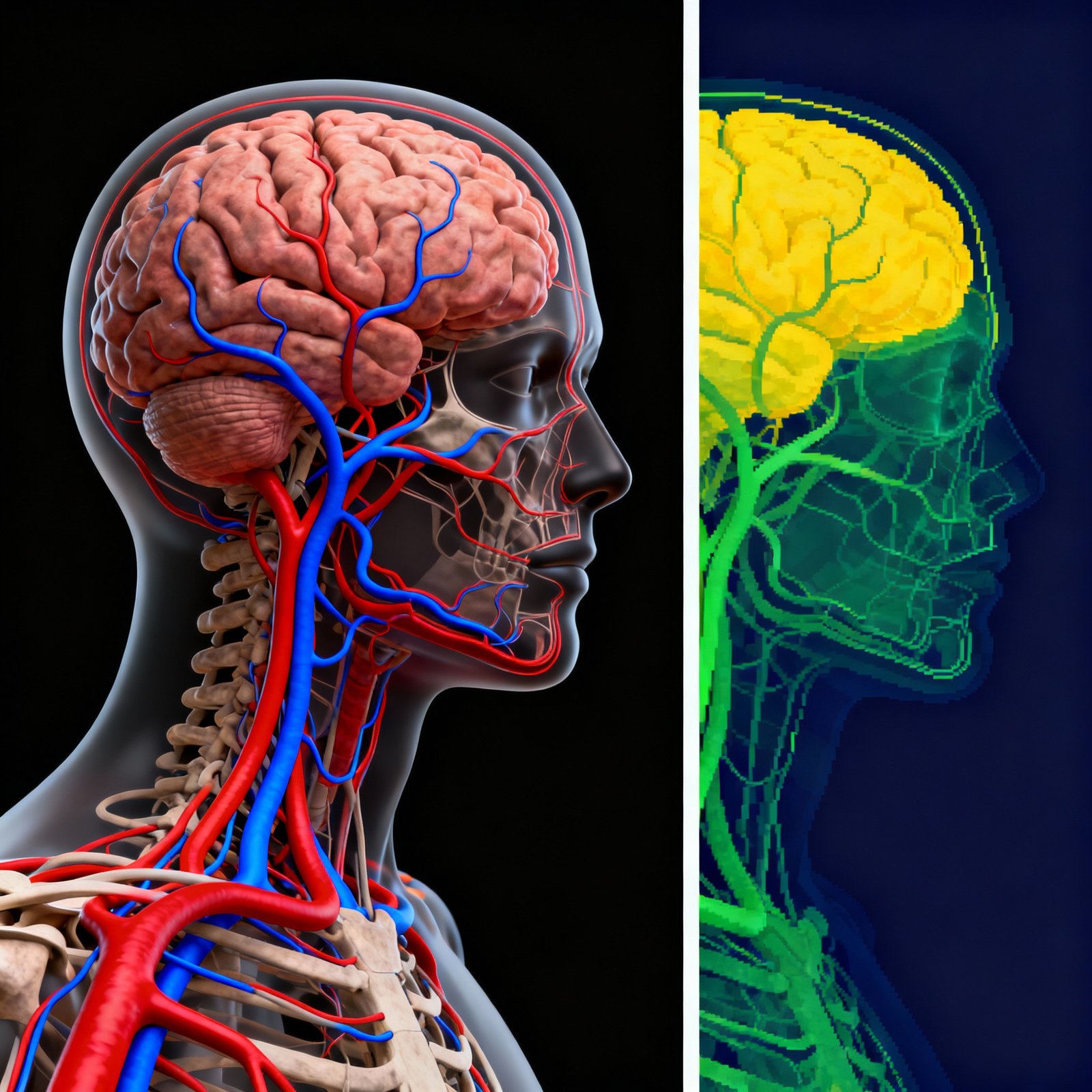
Your brain represents only 2% of your body weight yet demands 15-20% of your cardiac output—a staggering energy requirement that underscores the critical importance of cerebral blood flow for cognitive function[1,2]. Brain blood flow, or cerebral perfusion, is the fundamental process through which oxygen, glucose, and nutrients reach neural tissue to sustain the metabolic demands of thinking, learning, and memory[3]. Recent research from 2024-2025 reveals that disruptions in this vital “plumbing system” can predict cognitive decline earlier and more accurately than traditional biomarkers, fundamentally changing how we understand the brain-cognition relationship[1,4].
The Brain-Blood Flow Connection
Cerebral perfusion operates through a sophisticated mechanism called neurovascular coupling—the active process through which blood vessels respond in space and time to neuronal activity[3,2]. When neurons become active during cognitive tasks, they release neurotransmitters like glutamate, which trigger a cascade of events involving astrocytes, endothelial cells, and smooth muscle cells to dilate cerebral vessels and increase local blood flow[2,3]. This coordinated multicellular response ensures that metabolically active brain regions receive adequate oxygen and glucose to support neural efficiency and brain tissue metabolism[2].
The process begins at the capillary level, where increases in extracellular potassium (K⁺) hyperpolarize endothelial cells, and this electrical signal propagates retrograde through gap junctions to upstream arterioles, causing them to relax and dilate[2,3]. Astrocytes play a central role by transmitting signals from neurons to blood vessels through calcium signaling, releasing vasoactive substances including prostaglandins and epoxyeicosatrienoic acids that modulate vascular tone[3]. This elegant system evolved specifically to match brain energy supply with neuronal demand, with up to 50% of oxygen extraction occurring in precapillary arterioles[2].
Key Point: Neurovascular coupling is the brain’s precision delivery system, matching blood flow to neuronal activity within seconds to ensure optimal cognitive performance.
Blood Flow’s Impact on Cognitive Domains
| Cognitive Domain | Brain Region | Impact of Reduced CBF |
|---|---|---|
| Executive Function | Frontal Lobe | Impaired planning, decision-making, working memory |
| Memory Formation | Temporal Lobe/Hippocampus | Reduced encoding, consolidation deficits |
| Attention | Parietal Lobe | Decreased sustained attention, distractibility |
| Processing Speed | White Matter Tracts | Slowed mental performance, reaction time delays |
Research consistently demonstrates that cerebral perfusion directly influences performance across multiple cognitive domains, particularly executive function, attention, and memory[5,6,7]. A 2024 University of Oklahoma study using functional near-infrared spectroscopy revealed striking differences in brain blood flow patterns during memory challenges: young adults showed robust blood flow increases to meet cognitive demands, while older adults with mild cognitive impairment exhibited drastically reduced blood flow and lost compensatory mechanisms[4]. This impairment in neurovascular coupling prevents adequate delivery of oxygen and glucose during mental tasks, directly compromising cognitive performance[4,1].
Specific brain regions show differential vulnerability to perfusion deficits, with reduced frontal lobe perfusion associated with worse executive function and memory, while temporal lobe hypoperfusion correlates with immediate memory impairment[5]. The frontal lobes, which mediate executive control and working memory, are particularly sensitive to disrupted cerebral hemodynamics due to their high metabolic demands and extensive vascular networks[5]. A 2025 meta-analysis confirmed that exercise enhances cognitive function in older adults by improving macrovascular cerebral blood flow and cardiovascular efficiency, demonstrating the bidirectional relationship between vascular health and mental performance[8].
Studies tracking patients over multiple years reveal that lower baseline cerebral blood flow predicts faster cognitive decline, particularly in attention, executive function, and memory domains[6,9]. Importantly, brain perfusion measurements now prove to be better predictors of mild cognitive impairment than traditional vascular risk factors like hypertension and high cholesterol[4]. This predictive power suggests that cerebral perfusion disruption may be an early, sensitive marker of cognitive vulnerability that appears before structural brain changes become evident[5,4].
Key Point: Reduced cerebral blood flow predicts cognitive decline better than traditional risk factors, making it a critical early warning sign for brain health deterioration.
Age-Related Changes and Brain Oxygenation
Cognitive aging involves progressive changes in cerebrovascular function that compromise brain oxygenation and neural efficiency[10,4]. Older adults with mild cognitive impairment show significantly greater resistance to brain blood flow compared to cognitively healthy peers, limiting the brain’s ability to increase perfusion during cognitive demands[10,4]. This vascular resistance reflects impaired vasomotor reactivity—the ability of cerebral vessels to dilate in response to increased carbon dioxide or metabolic needs[1].
A groundbreaking 2025 USC Viterbi study found that Alzheimer’s patients cannot adequately dilate cerebral vessels to increase blood perfusion, preventing timely delivery of oxygen, nutrients, and glucose essential for cognition[1]. This dysregulation of the brain’s “plumbing system” may cause cognitive impairment independent of amyloid plaques, challenging prevailing theories of dementia pathogenesis[1]. Even in normal aging, reduced cerebral perfusion associates with smaller total brain volume, decreased cortical thickness, and vulnerability to hypoxic episodes that particularly affect memory-critical temporal lobe structures like the hippocampus[5].
The loss of compensatory mechanisms represents a critical threshold in cognitive aging: while healthy older adults maintain function by recruiting additional brain regions when blood flow is reduced, individuals with mild cognitive impairment lose this plasticity, leaving them vulnerable to further decline[4]. By 2050, dementia is projected to affect 152 million people worldwide, with approximately 18% of the global population currently experiencing mild cognitive impairment—underscoring the urgent need to understand and intervene in cerebrovascular dysfunction before irreversible cognitive decline occurs[4].
Key Point: Vascular dysfunction, not just amyloid pathology, drives cognitive decline—opening new therapeutic avenues targeting cerebral blood flow.
Takeaway
Brain blood flow emerges as a fundamental determinant of cognitive function and learning capacity, operating through the sophisticated neurovascular coupling system that matches energy supply to neural demand[3,2]. The evidence from 2024-2025 research establishes that cerebral perfusion measurements can predict cognitive decline earlier than traditional biomarkers, offering new opportunities for early intervention to preserve cognitive vitality[1,4]. Understanding the brain’s vascular dynamics—rather than focusing solely on structural pathology—may revolutionize how we diagnose, prevent, and treat age-related cognitive decline and dementia[1].
“The brain’s ‘plumbing system’ may be just as important as amyloid plaques in driving cognitive decline—targeting cerebral blood flow could open entirely new therapeutic avenues.”
— USC Viterbi Research Team, 2025
References
- Brain’s Blood Flow Could Change How We Understand and Treat Alzheimer’s. USC Viterbi School of Engineering. Published August 20, 2025. https://viterbischool.usc.edu/news/2025/08/brains-blood-flow-could-change-how-we-understand-and-treat-alzheimers/
- Neurovascular coupling: a review of spontaneous neocortical activity. Journal of Neurophysiology. 2025;133(2):567-589. doi:10.1152/jn.00418.2024
- Neurovascular Coupling – an overview. ScienceDirect Topics. Accessed October 26, 2025. https://www.sciencedirect.com/topics/neuroscience/neurovascular-coupling
- Brain Vasculature Changes Important for Predicting Cognitive Impairment. University of Oklahoma News. Published September 15, 2024. http://www.ou.edu/news/articles/2024/september/brain-vasculature-changes-important-for-predicting-cognitive-impairment.html
- Marshall RS, Lazar RM. The adverse effects of reduced cerebral perfusion on cognition and brain structure. Brain Imaging and Behavior. 2013;7(4):493-506. doi:10.1007/s11682-013-9244-3
- Wolters FJ, Zonneveld HI, Hofman A, et al. Cerebral Perfusion and the Risk of Dementia: A Population-Based Study. Circulation. 2017;136(8):719-728. doi:10.1161/CIRCULATIONAHA.117.027448
- Cerebral perfusion differences are linked to executive function deficits in older adults. Journal of Alzheimer’s Disease. 2024;97(2):543-557. doi:10.3233/JAD-230892
- A meta-analysis of macrovascular cerebral blood flow and cognitive function in older adults. Published July 23, 2025. https://pubmed.ncbi.nlm.nih.gov/40515719/
- Benedictus MR, Leeuwis AE, Binnewijzend MAA, et al. Lower cerebral blood flow is associated with faster cognitive decline in Alzheimer’s disease. Alzheimer’s & Dementia. 2024;19(S3):e067234. doi:10.1002/alz.13408
- Brain Blood Flow Resistance More Common in Older Adults with Cognitive Problems. American Physiological Society. Published October 21, 2024. https://www.physiology.org/detail/news/2024/10/22/
Useful Resources
- National Institute on Aging – Brain Health: Comprehensive resource on brain aging, cognitive health, and research advances from the leading U.S. federal agency.
- American Heart Association – Stroke Journal: Peer-reviewed research on cerebrovascular health, stroke prevention, and vascular contributions to cognitive impairment.
- Alzheimer’s Society UK – Risk Factors and Prevention: Evidence-based guidance on modifiable risk factors including vascular health for dementia prevention.
- Neurovascular Imaging Journal: Latest research on cerebral blood flow imaging techniques and clinical applications in neurology.
Frequently Asked Questions
How can I improve my brain blood flow naturally?
Regular aerobic exercise is the most effective intervention, with the 2025 meta-analysis[8] confirming that consistent physical activity improves macrovascular cerebral blood flow and cognitive function in older adults. Additionally, maintaining healthy blood pressure through cardiovascular management and consuming a Mediterranean-style diet rich in omega-3 fatty acids supports vascular health.
Can reduced brain blood flow be reversed?
While age-related vascular changes cannot be completely reversed, research shows[4] that early intervention with exercise and vascular risk factor management can restore compensatory mechanisms and improve neurovascular coupling. The key is addressing perfusion deficits before structural brain damage occurs.
How is cerebral blood flow measured?
Clinicians use several imaging techniques including arterial spin labeling (ASL) MRI, transcranial Doppler ultrasound, and functional near-infrared spectroscopy (fNIRS). ASL-MRI is considered the gold standard for non-invasive quantitative assessment of regional cerebral perfusion in research and clinical settings.
At what age does brain blood flow start declining?
According to longitudinal studies,[5] cerebral blood flow begins gradually declining around age 40, with an accelerated reduction after age 60. However, the rate varies significantly based on cardiovascular health, with vascular resistance increasing more rapidly[10] in those with hypertension, diabetes, or other risk factors.
Is poor circulation linked to dementia?
Yes, the groundbreaking 2025 USC study[1] found that Alzheimer’s patients show impaired vascular dilation, preventing adequate oxygen and glucose delivery independent of amyloid pathology. The Framingham Heart Study[6] confirmed that low cerebral perfusion significantly increases dementia risk, establishing vascular dysfunction as a primary contributor to cognitive decline.
Future Blog Topics
| Upcoming Topic | Why It Matters |
|---|---|
| Exercise Prescriptions for Brain Health: Optimizing Intensity and Duration | New 2025 research reveals specific exercise protocols that maximize cerebral perfusion and cognitive benefits across different age groups. |
| The Gut-Brain-Vascular Axis: How Microbiome Health Affects Cerebral Blood Flow | Emerging evidence links gut inflammation to endothelial dysfunction and reduced brain perfusion, opening dietary intervention opportunities. |
| Neurovascular Imaging: The Future of Early Dementia Detection | Advanced perfusion imaging techniques now detect cognitive risk 5-10 years before symptoms appear, revolutionizing prevention strategies. |



Leave a Reply