
Introduction
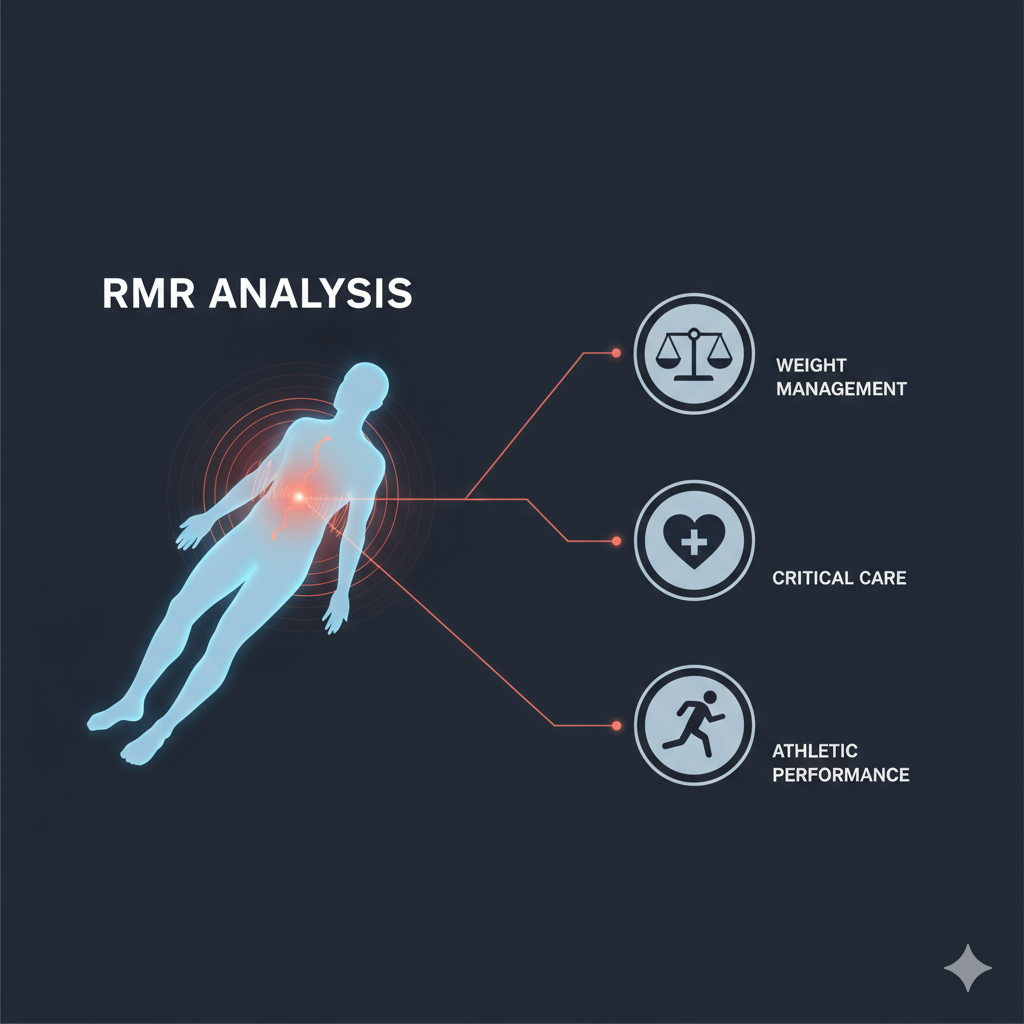
What if you were told that the vast majority of calories you burn each day are expended while doing nothing at all? It sounds counterintuitive, but it’s a physiological fact. The Resting Metabolic Rate (RMR) accounts for 60-75% of your total daily energy expenditure (TDEE).[1] RMR represents the energy required to maintain essential bodily functions—like breathing, circulation, and cell production—while you’re in a state of complete rest.[2] Understanding this fundamental metabolic baseline is not just a matter of curiosity; it’s a cornerstone of modern clinical nutrition. Accurately measuring or estimating RMR is crucial for designing effective weight management strategies, nourishing critically ill patients, and optimizing athletic performance, moving care from generalized advice to personalized, data-driven science.
| Objective | Outcome |
|---|---|
| Define the principles of RMR. | You will understand what RMR is and how it’s measured. |
| Identify key factors that influence RMR. | You will learn why metabolism varies between individuals. |
| Explore the clinical applications of RMR. | You will see how RMR data informs patient care. |
The Principles of RMR Measurement
Determining an individual’s RMR isn’t guesswork; it’s a science. The gold-standard method is Indirect Calorimetry (IC). This technique measures gas exchange—specifically, the volume of oxygen consumed (VO₂) and carbon dioxide produced (VCO₂) at rest.[3] The principle is straightforward: the body’s energy production is an oxidative process. By quantifying the oxygen used and carbon dioxide created, we can accurately calculate the energy expended in real-time.[4] The test involves having a person rest comfortably for about 10-30 minutes while breathing into a ventilated hood or mouthpiece connected to a metabolic analyzer.[5]
However, IC equipment is expensive and not always available. Consequently, clinicians often rely on predictive equations. For decades, the Harris-Benedict equation was standard, but research has shown it can be inaccurate. Today, the Mifflin-St Jeor equation is considered more accurate for a broader population and is recommended by the Academy of Nutrition and Dietetics.[6] These formulas use variables like age, sex, height, and weight to estimate RMR. While convenient, they are still just estimations and may not capture the unique metabolic variations of an individual, especially in clinical populations.
Key Point: While predictive equations are useful, Indirect Calorimetry remains the most accurate method for determining an individual’s true Resting Metabolic Rate.
Key Factors That Influence RMR
RMR is not a one-size-fits-all number. It varies significantly between individuals due to a host of factors, which can be broadly categorized as non-modifiable and modifiable.[7] Understanding these factors is key to interpreting RMR values correctly and providing personalized advice.
| Non-Modifiable Factors | Modifiable Factors |
|---|---|
| Age: RMR naturally declines with age, partly due to loss of muscle mass.[7] | Fat-Free Mass: Muscle is more metabolically active than fat. More muscle equals a higher RMR.[7] |
| Biological Sex: Men generally have a higher RMR than women, primarily due to higher muscle mass.[7] | Low-Calorie Intake: Severe dieting can lower RMR by up to 20% as the body conserves energy.[7] |
| Genetics: Metabolic rates tend to be similar among family members, indicating a genetic component.[7] | Physiological Stress: Illness, injury, or surgery increases RMR as the body requires more energy to heal.[7] |
| Thyroid Hormones: These hormones are key regulators of metabolism; levels can raise or lower RMR.[7] | Growth: Periods of growth, such as in children or athletes building muscle, require more energy.[7] |
The most significant contributor to RMR is fat-free mass (FFM), which includes muscles, organs, and bones. Since muscle tissue is highly metabolically active, building or preserving it through strength training is one of the most effective ways to maintain or increase RMR. Conversely, very low-calorie diets can trigger a “starvation response,” causing the body to become more energy-efficient and slowing metabolism, which can hinder weight loss efforts over time.[7]
RMR in Clinical Practice
Measuring RMR provides actionable data that transforms patient care across several domains.
- Weight Management: For individuals trying to lose weight, knowing their precise RMR is invaluable. It allows for the creation of a sustainable calorie deficit that promotes fat loss while preserving metabolically active muscle mass.[8] It helps identify a “weight loss zone” and can reveal metabolic adaptation when a weight loss plateau occurs, allowing for data-driven adjustments.[9]
- Critical Care Nutrition: In the intensive care unit (ICU), the metabolic demands of critical illness can fluctuate dramatically. The stress response can lead to hypermetabolism, increasing caloric needs significantly.[10] Using IC to measure RMR helps prevent both underfeeding, which can lead to malnutrition and muscle wasting, and overfeeding, which can cause complications.
- Athletic Performance: Elite athletes must balance energy intake with extreme energy expenditure. RMR provides the baseline caloric need, which is then adjusted for training demands. This ensures adequate fueling to optimize performance, enhance recovery, and prevent low energy availability, which can lead to injury and burnout.[8]
Takeaway
Resting Metabolic Rate is far more than an academic concept; it’s a dynamic and personalized metric that reflects an individual’s unique physiology. Moving beyond generic, formula-based caloric recommendations and toward measured RMR allows clinicians and individuals to make highly informed, effective decisions about nutrition. Whether the goal is managing weight, recovering from critical illness, or achieving peak physical performance, understanding the body’s baseline energy needs is the essential first step.
“Pinpointing the precise number of calories necessary to maintain is key… Most overweight people are convinced they have a slow metabolism. The truth is that statistically, most overweight and obese individuals have average or higher than average metabolic rates.”
— KORR Medical Technologies[5]
References
- Kim JY, Park J, Lim K. Accuracy of predicted resting metabolic rate and relationship between resting metabolic rate and cardiorespiratory fitness in obese men. J Exerc Nutrition Biochem. 2014;18(4):347-353. doi:10.5717/jenb.2014.18.4.347
- Sabounchi NS, Rahmandad H, Ammerman A. Best-fitting prediction equations for basal metabolic rate: a systematic review. J Am Diet Assoc. 2013;113(7):902-910. doi:10.1016/j.jand.2013.04.004
- da Rocha EE, Alves VG, da Fonseca RB. Indirect calorimetry: methodology, instruments and clinical application. Curr Opin Clin Nutr Metab Care. 2016;19(3):207-213. doi:10.1097/MCO.0000000000000270 PMID:
- Haugen HA, Chan LN, Li F. Indirect calorimetry: a practical guide for clinicians. Nutr Clin Pract. 2007;22(4):377-388. doi:10.1177/0115426507022004377 PMID: 17644692
- KORR Medical Technologies. Resting Metabolic Rate (RMR). Accessed October 20, 2025.
- Frankenfield D, Roth-Yousey L, Compher C. Comparison of predictive equations for resting metabolic rate in healthy nonobese and obese adults: a systematic review. J Am Diet Assoc. 2005;105(5):775-789. doi:10.1016/j.jada.2005.02.005 PMID: 15883556
- Johnstone AM, Murison SD, Duncan JS, Rance KA, Speakman JR. Factors influencing variation in basal metabolic rate include fat-free mass, fat mass, age, and circulating thyroxine but not sex, circulating leptin, or triiodothyronine. Am J Clin Nutr. 2005;82(5):941-948. doi:10.1093/ajcn/82.5.941 PMID: 16280423
- Donahoo WT, Levine JA, Melanson EL. Variability in energy expenditure and its components. Curr Opin Clin Nutr Metab Care. 2004;7(6):599-605. doi:10.1097/00075197-200411000-00003 PMID: 15534426
- Müller MJ, Bosy-Westphal A. Adaptive thermogenesis with weight loss in humans. Obesity (Silver Spring). 2013;21(2):218-228. doi:10.1002/oby.20027 PMID: 23404923
- Singer P, Blaser AR, Berger MM, et al. ESPEN guideline on clinical nutrition in the intensive care unit. Clin Nutr. 2019;38(1):48-79. doi:10.1016/j.clnu.2018.08.037
Useful Resources
- National Institute of Diabetes and Digestive and Kidney Diseases (NIDDK): Provides information on metabolism and weight management myths.
- Academy of Nutrition and Dietetics: Offers resources on nutrition and finding a registered dietitian.
- American Council on Exercise (ACE): Explains RMR and strategies to influence it through exercise.
- A Clinical Guide to Calculating Basal and Resting Energy Expenditure: A detailed review for clinicians on measurement and equations.
Frequently Asked Questions
1. What’s the difference between RMR and BMR (Basal Metabolic Rate)?
RMR and BMR are very similar but have slightly different measurement conditions. BMR is measured under stricter, clinically controlled conditions after a full night’s sleep and a 12-hour fast. RMR is less restrictive and is usually about 10% higher than BMR. For most practical purposes, the terms are used interchangeably. This clinical guide provides more detail on the differences.
2. Can I increase my RMR?
Yes, to an extent. The most effective way is by increasing your fat-free mass through resistance (strength) training. Since muscle is more metabolically active than fat, building muscle will raise your RMR. Avoiding severe calorie restriction is also important to prevent your metabolism from slowing down. You can learn more from the American Council on Exercise.
3. How accurate are the RMR calculators I find online?
Most online calculators use a predictive equation, typically the Mifflin-St Jeor formula, which is the most accurate for the general population. However, they are still estimates. Your actual RMR could be higher or lower. For clinical accuracy, Indirect Calorimetry is the recommended method.
4. Does a “slow metabolism” cause weight gain?
It’s complicated. While genetics play a role, it’s rare for a slow metabolism to be the sole cause of weight gain without an underlying medical issue (like hypothyroidism). In fact, larger individuals often have a higher RMR because they have more body mass to support. Weight gain is more often a result of an imbalance between calories consumed and total calories burned. The NIDDK offers excellent resources on this topic.
5. How often should RMR be measured?
It depends on the context. In a critical care setting, it might be measured daily. For weight management, a measurement at the beginning of a program and another after significant weight loss (e.g., 10% of body weight) can be useful to adjust caloric targets, as RMR will decrease with weight loss. Discuss the best frequency with your registered dietitian or healthcare provider.
Future Blog Topics
| Upcoming Article | Coming Soon | Why It Matters |
|---|---|---|
| Metabolic Adaptation: Why Weight Loss Stalls | November 2025 | Understand the physiological reasons behind weight loss plateaus and how to overcome them. |
| The Impact of Exercise on RMR and TDEE | December 2025 | A deep dive into how different types of exercise affect your metabolism, both during and after your workout. |
| RMR in Chronic Disease: A Look at Heart Failure and COPD | January 2026 | Explore how chronic illnesses can alter metabolic rates and why personalized nutrition is critical. |




Leave a Reply