Introduction
Ever felt your energy drain and your focus drift during a long lecture? You’re not just bored—your body and brain are struggling. Hours of uninterrupted sitting can slow your circulation, starve your brain of oxygen-rich blood, and tank your ability to learn. But what if the solution wasn’t more caffeine, but more movement? Researchers have developed a simple yet powerful framework called SitLESS (Sitting Less for Engagement and Student Success) to do just that.
Key Point: Brief, structured movement breaks can counteract the negative effects of prolonged sitting, boosting both your health and your grades.
| Key Questions Answered in this Article |
| What is prolonged sitting really doing to your body’s circulation? |
| How does a lack of movement directly impact your brain’s ability to learn? |
| What is the SitLESS framework and how can it be used in any classroom? |
| Do movement breaks actually improve student engagement and success? |
The Hidden Toll of Sitting on Your Body
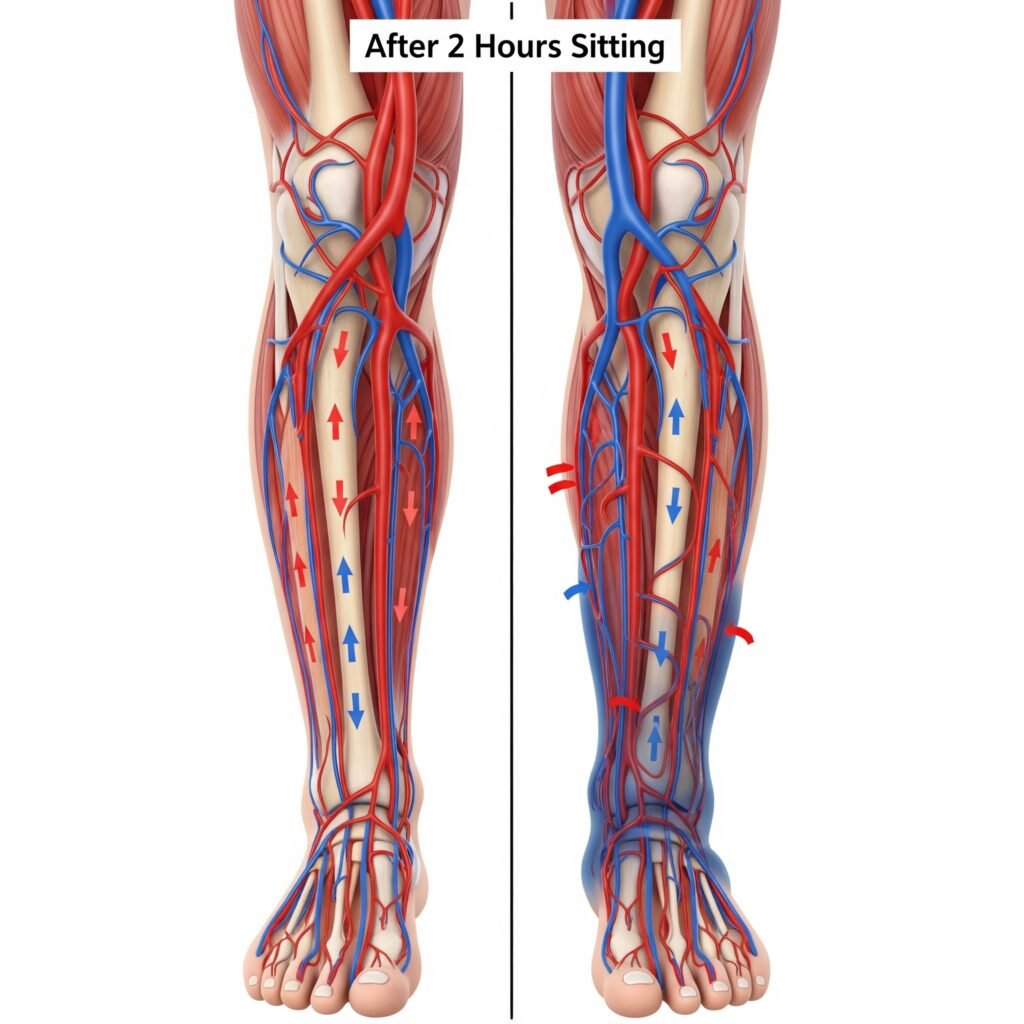
When you sit for long periods, your muscles go quiet. This inactivity causes blood to pool in your legs, making your blood vessels sluggish and stiff. Our lab and others have found that just a few hours of sitting can reduce the healthy function of your blood vessels by up to 60%. This isn’t a long-term problem that happens over years; it’s an immediate, measurable effect that happens every time you sit through a long class.
Key Point: Uninterrupted sitting quickly impairs your vascular health by causing blood to pool and reducing blood flow, especially in your lower body.
How Sitting Saps Your Brainpower
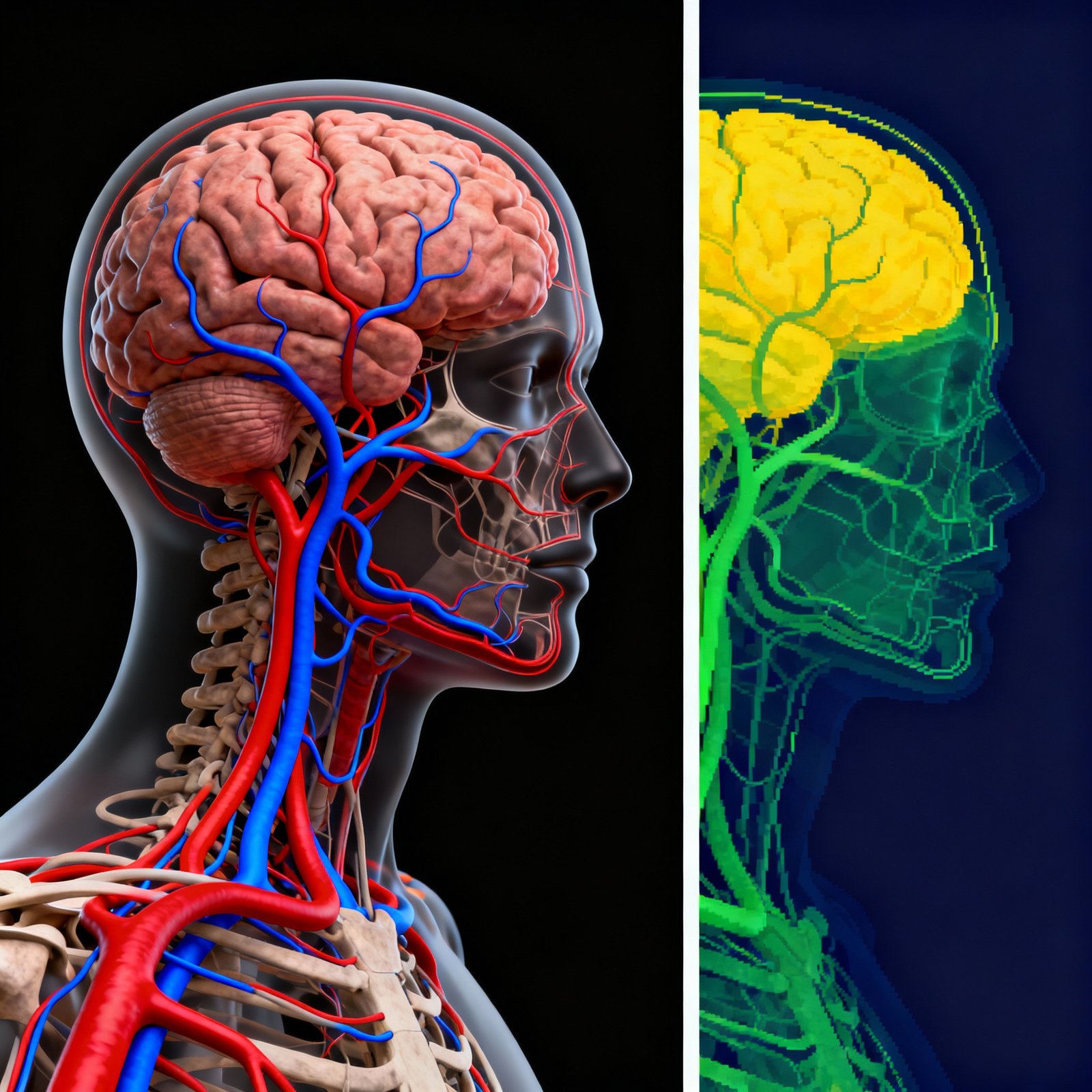
The problems don’t stop at your legs. Prolonged sitting also reduces blood flow to your brain. Key areas responsible for focus, problem-solving, and memory—known as executive functions—don’t get the fuel they need to perform optimally. This can lead to mental fatigue and make it much harder to absorb and retain complex information. Studies show these negative changes can begin after just one hour of sitting.
Key Point: Your brain needs strong, steady blood flow to learn effectively, and sitting for too long actively works against that process.
| Impact of Sitting vs. Movement on Learning |
| Prolonged Sitting |
| Reduced blood flow to the brain |
| Increased mental fatigue |
| Impaired cognitive performance |
| Lower engagement |
The SitLESS Solution: Simple, Powerful Ways to Get Moving
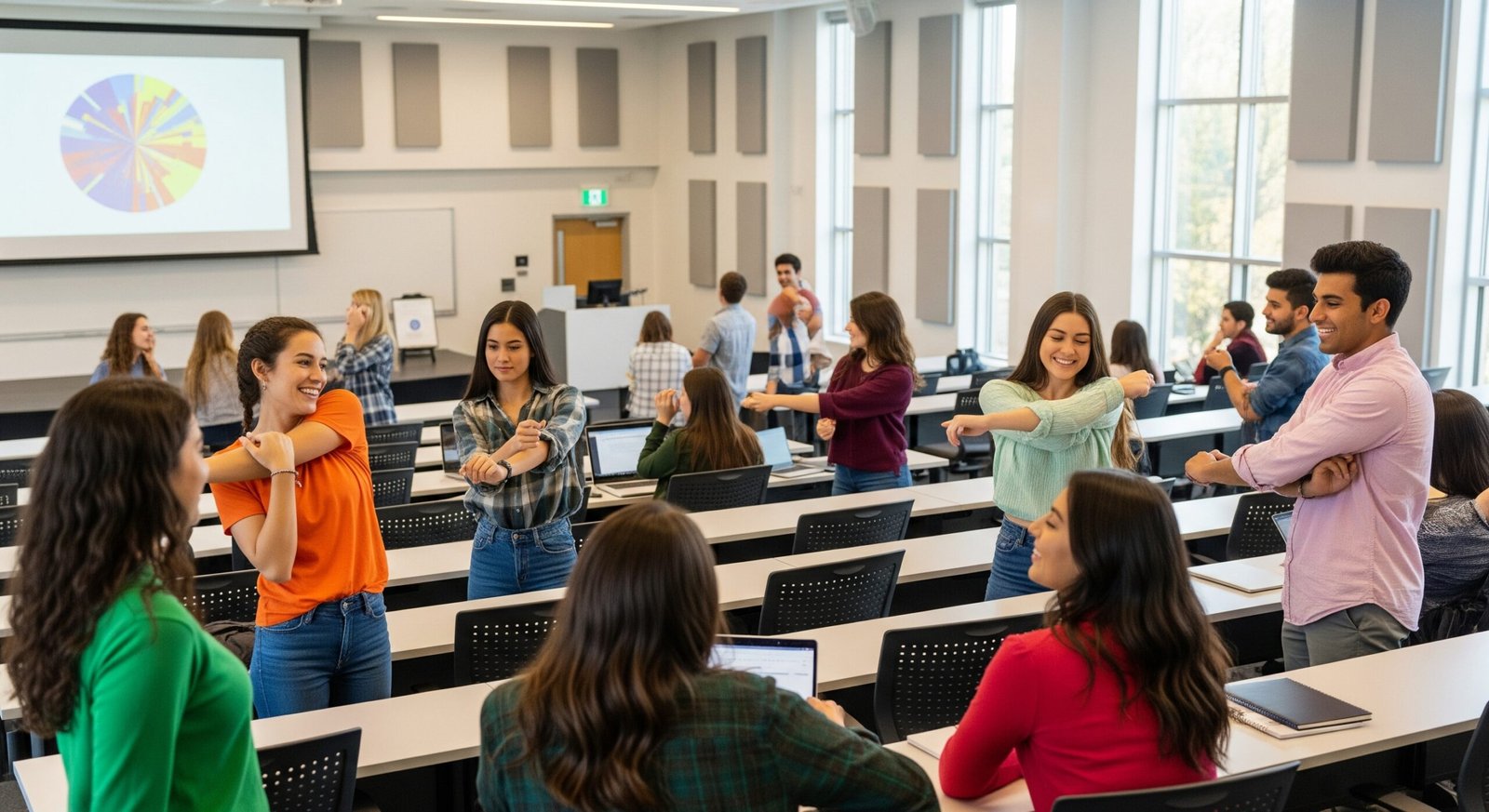
The SitLESS framework was designed to be a practical toolkit for any instructor. It’s not about turning a lecture into a gym class; it’s about integrating short, purposeful movements that refresh the body and refocus the mind. These strategies are flexible, inclusive, and easy to implement even in large lecture halls.
Key Point: The SitLESS model provides scalable, instructor-friendly strategies to break up sedentary time without disrupting the flow of a lesson.

Here are some of the core strategies:
- Stretch-and-Reflect: A 1-3 minute break where students stand, stretch, and think about a key concept from the lecture.
- Walk-and-Talk: Students pair up and walk around the room while discussing a prompt, combining peer learning with light activity.
- Active Polling: Instead of using clickers, students stand up to indicate their answer to a multiple-choice question.
- Deskercises: Simple movements like calf raises or shoulder rolls that can be done while standing or sitting at a desk.
What Students and Teachers Think
So, does it actually work? The feedback is overwhelmingly positive. In surveys, over 70% of students reported that movement breaks helped increase their engagement and improve their performance in class. They felt more focused, less tired, and more involved in the material. Educators also embraced the model, with nearly all instructors in a professional development session reporting that they learned scalable strategies they could confidently use in their own courses.
Key Point: Both students and educators find that SitLESS breaks improve the classroom experience, boosting engagement and making learning more enjoyable.
| Educator Feedback on the SitLESS Framework (N=30) |
| Survey Finding |
| Overall satisfaction |
| Movement enhances learning |
| Learned scalable strategies |
| Active learning is inclusive |
Takeaway
The modern classroom can unintentionally put students’ health and learning at risk through prolonged sitting. The SitLESS framework demonstrates that the solution is simple, effective, and requires no expensive equipment or radical changes. By thoughtfully embedding short bursts of movement into lectures, we can create learning environments that are more dynamic, inclusive, and far more effective.
Key Point: Integrating movement into the classroom is a powerful, evidence-based strategy to support student well-being and academic success simultaneously.
Sources
- Credeur DP, Miller SM, Jones R, et al. Impact of Prolonged Sitting on Peripheral and Central Vascular Health. The American Journal of Cardiology. 2019;123(2):260-266. doi:10.1016/j.amjcard.2018.10.014 (PMID: 30420216)
- Stoner L, Willey Q, Evans WS, Burnet K, Credeur DP, Fryer S, & Hanson ED. Effects of acute prolonged sitting on cerebral perfusion and executive function in young adults: A randomized cross-over trial. Psychophysiology. 2019;56(12):e13457. doi:10.1111/psyp.13457 (PMID: 31393630)
- Paterson C, Fryer S, Zieff G, et al. The Effects of Acute Exposure to Prolonged Sitting, With and Without Interruption, on Vascular Function Among Adults: A Meta-analysis. Sports Medicine. 2020;50(11):1929-1942. doi:10.1007/s40279-020-01325-5 (PMID: 32617912)
- Castro O, Bennie J, Vergeer I, Bosselut G, & Biddle SJH. How Sedentary Are University Students? A Systematic Review and Meta-Analysis. Prevention Science. 2020;21(3):332-343. doi:10.1007/s11121-020-01093-8 (PMID: 32060633)
- Peiris CL, O’Donoghue G, Rippon L, et al. Classroom Movement Breaks Reduce Sedentary Behavior and Increase Concentration, Alertness and Enjoyment during University Classes: A Mixed-Methods Feasibility Study. International Journal of Environmental Research and Public Health. 2021;18(11):5589. doi:10.3390/ijerph18115589 (PMID: 34073384)
Useful Resources
- Explore Active Learning Strategies: Visit the Vanderbilt University Center for Teaching to discover dozens of active learning techniques you can suggest to your instructors.
- Try Some Deskercises: Check out this guide from the American Heart Association for simple, effective exercises you can do at your desk to break up sitting time.
- Understand Sedentary Behavior: Read the World Health Organization’s fact sheet on physical activity to learn more about the global health risks of sitting too much.
FAQs
- Won’t movement breaks disrupt the class? When planned and structured, these breaks are very brief (1-3 minutes) and actually help refocus the class, reducing the disruption that comes from students losing attention.
- What if I have a physical limitation or feel uncomfortable participating? The SitLESS framework is designed for inclusion. It emphasizes offering seated options, simple stretches, or “opt-out” choices so no one feels singled out. The goal is movement, not mandatory exercise.
- How can I convince my professor to try this? Share this article! You can also mention that active learning strategies are supported by a growing body of research showing they improve student outcomes and satisfaction. Frame it as a way to help everyone stay engaged.
Future Blog Articles
| Topic | Why this Topic? |
| The Ultimate Guide to ‘Deskercises’ | Provides a deep dive into practical, easy-to-implement movements for any student or office worker. |
| Designing the Active Classroom | Explores how classroom layout, furniture, and technology can encourage movement and improve learning. |
| The Neuroscience of Focus | A closer look at how physical activity directly fuels the brain regions responsible for attention and memory. |

Leave a Reply