
By Dr. Jeongok Logan & Dr. Lee Stoner
Most of us think of stretching as something you do before a run: a quick, obligatory routine to protect your hamstrings. But what if that five-minute stretch was quietly doing something far more important? What if it was training your blood vessels?
A growing body of research shows that regular stretching, particularly static stretching, improves blood pressure, reduces arterial stiffness, and enhances the function of the cells lining your blood vessels.1 These are the same markers your doctor watches when assessing your cardiovascular risk. The science is clear: stretching is an underutilized, evidence-based tool for improving cardiovascular health that goes far beyond flexibility.
In this article, you’ll discover exactly how stretching benefits your heart and blood vessels, and how little it takes to make a real difference.
| What You’ll Learn | Why It Matters |
|---|---|
| How stretching triggers vascular responses | Understand the mechanism behind cardiovascular benefit |
| What arterial stiffness is and why it matters | Recognise a key, overlooked risk factor for heart disease |
| Static vs dynamic stretching: which is better for your heart | Make informed choices about your stretching practice |
| Evidence-based dosing: how much stretching is enough | Build a routine that delivers real cardiovascular results |
What Happens in Your Blood Vessels When You Stretch?
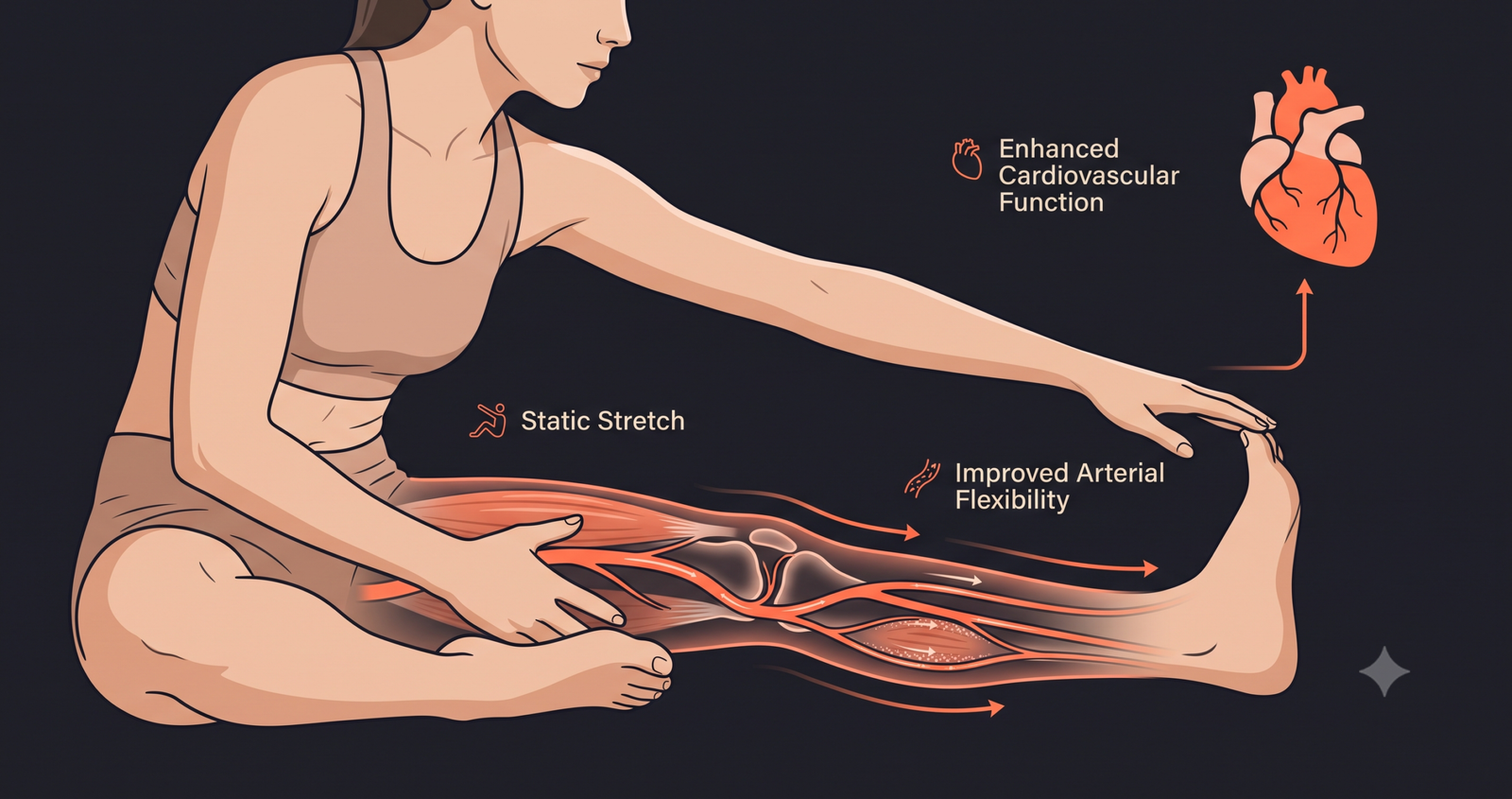
When you stretch a muscle, you’re not just lengthening fibers; you’re creating mechanical forces that ripple through your entire vascular system. As the muscle and surrounding tissue deform, blood flow patterns change, generating what’s called shear stress on the inner walls of your blood vessels. Think of shear stress like water rushing faster through a hose when you squeeze it: the increased friction signals the vessel walls to respond.
That response begins with the endothelium, the single-cell layer lining every blood vessel in your body. When shear stress increases, endothelial cells ramp up production of nitric oxide (NO), a molecule that relaxes the vessel wall and widens the artery.5 Daily stretching has been shown to enhance blood flow and improve endothelial function through exactly this mechanism.4 Over time, repeated exposure to these signals remodels your vessels, making them more responsive, more flexible, and better at regulating blood pressure.
Every time you stretch, your blood vessels receive a signal to relax, widen, and work more efficiently.
Arterial Stiffness: The Hidden Risk Factor
| Study | Intervention | Key Finding | Effect |
|---|---|---|---|
| Kato et al., 20201 | Meta-analysis, 8 RCTs | Reduced arterial stiffness + improved endothelial function | SMD −1.00 (p=0.0004) |
| Nishiwaki et al., 20173 | 3-month static stretching | Improved endothelial function; arterial stiffness reduced at 6 months | Reversed by detraining |
| Kato et al., 20201 | Pooled analysis | Diastolic BP reduced | MD −2.72 mmHg (p<0.0001) |
Arterial stiffness is exactly what it sounds like: your arteries becoming less elastic, less able to expand and contract smoothly with each heartbeat. It’s a major independent risk factor for cardiovascular disease, yet it barely features in everyday health conversations. Your doctor might check your blood pressure, but arterial stiffness often goes unmeasured until something goes wrong.
Here’s the good news. A 2020 meta-analysis of eight randomized and non-randomized controlled trials found that muscle stretching exercises significantly reduced arterial stiffness and improved vascular endothelial function (SMD: −1.00, 95% CI: −1.57 to −0.44).1 Diastolic blood pressure dropped by an average of 2.72 mmHg, a clinically meaningful reduction for a zero-equipment intervention. Importantly, a 3-month static stretching program improved endothelial function, with arterial stiffness improvements following after a sustained 6-month intervention, though these gains reversed with detraining.3
Stretching doesn’t just feel good; it produces measurable, clinically meaningful reductions in a key cardiovascular risk factor.
Static vs Dynamic: Does the Type of Stretch Matter?
Not all stretching is identical when it comes to cardiovascular benefit. Static stretching (holding a position for 20–60 seconds) and dynamic stretching (moving through a range of motion repeatedly) engage different physiological pathways. Static stretching produces a more sustained mechanical stimulus on blood vessel walls, favoring the prolonged shear stress that drives nitric oxide production and endothelial adaptation.5
Dynamic stretching, by contrast, activates both mechanoreceptors and metaboreceptors more vigorously, producing a greater acute blood pressure elevation during the activity itself. A 2026 review found that both static and dynamic modalities reduced blood pressure in hypertensive individuals, though static stretching showed the more consistent long-term signal across studies.6 The practical takeaway: static stretching is your primary tool for vascular benefit, while dynamic stretching remains valuable for warm-up and when combined with aerobic training.
Static stretching has the strongest sustained evidence for vascular benefit, but both modalities contribute meaningfully to cardiovascular health.
How Much Is Enough? Dosing and Consistency
The research points to a clear dosing signal: daily stretching of 10–15 minutes, focusing on the lower limb muscles (calves, hamstrings, and hip flexors), produces the most consistent vascular adaptations. Lower-limb stretching generates the greatest shear stress in the femoral and popliteal arteries, which have been the most studied vessels in passive stretching trials.2 A 12-week passive stretching program produced improvements in vascular function and arterial remodeling throughout the body, not just in the stretched limb, suggesting systemic cardiovascular effects.2
There’s one critical caveat: the effects reverse with detraining. Nishiwaki et al. found that vascular improvements gained over 6 months returned to baseline after the stretching program was discontinued.3 This makes consistency non-negotiable, not as an onerous demand but as a motivating framing: a 10-minute daily habit, maintained over weeks, is all that stands between you and measurably healthier arteries.
Just 10–15 minutes of stretching daily, sustained over 4–12 weeks, is enough to produce meaningful cardiovascular adaptation.
Takeaway
The evidence is consistent and compelling: stretching is far more than a flexibility tool. Regular static stretching reduces arterial stiffness, lowers diastolic blood pressure, enhances nitric oxide bioavailability, and improves the function of the cells lining your blood vessels, all without a gym, equipment, or significant time commitment. It is one of the most accessible non-pharmacological strategies for cardiovascular health available.
“Muscle stretching exercises were shown to significantly reduce arterial stiffness and improve vascular endothelial function.”1
Kato et al. (2020), Int J Environ Res Public Health
References
- Kato M, Nihei Green F, Hibi M, et al. The efficacy of stretching exercises on arterial stiffness in middle-aged and older adults: a meta-analysis of randomized and non-randomized controlled trials. Int J Environ Res Public Health. 2020;17(16):5643. PMID: 32764418
- Bisconti AV, Cè E, Longo S, et al. Evidence for improved systemic and local vascular function after long-term passive stretching training of the hamstrings. J Physiol. 2020. Zenodo:5153062
- Nishiwaki M, Yonemura H, Kurobe K, Yamamoto M. Four weeks of regular static stretching reduces arterial stiffness in middle-aged men. Springerplus. 2015;4:555. PMID: 28287021
- Hotta N, Shi Y, Watanabe K, et al. Daily muscle stretching enhances blood flow, endothelial function, capillarity, vascular volume and connectivity in aged skeletal muscle. J Physiol. 2018;596(10):1903–1917. PMID: 29623692
- Kruse NT, Scheuermann BW. Cardiovascular responses to skeletal muscle stretching: “stretching” the truth or a new exercise paradigm for cardiovascular medicine? Sports Med. 2017;47(12):2507–2520. PMID: 28780647
- Themistocleous IC, et al. Effects of different types of stretching on hypertension. PMC. 2026. PMID: 42029532
- Lopes S, Gonçalves A, Correia MV, Amado F, Vilarinho R. Acute effects of different static stretching exercises orders on cardiovascular and autonomic responses. J Strength Cond Res. 2021. PMID: 31673012
- Kruse NT, Silette CR, Scheuermann BW. Influence of passive stretch on muscle blood flow, mean arterial pressure and leg vascular conductance during systemic hypoxia in healthy young adults. Am J Physiol Heart Circ Physiol. 2016. PMID: 27856718
Frequently Asked Questions
Is stretching as effective as aerobic exercise for cardiovascular health?
Stretching is not a replacement for aerobic exercise, but it provides complementary vascular benefits, particularly for arterial stiffness and endothelial function, that aerobic training does not fully replicate. For individuals who cannot tolerate high-intensity exercise, stretching offers a meaningful low-impact alternative. See Kato et al. (2020) for a full comparison.
How quickly will I see cardiovascular benefits from stretching?
Endothelial function improvements can appear within 3 months of consistent static stretching. Arterial stiffness reductions typically require 4–6 months of sustained practice. Acute effects on blood flow are observable after a single session, but durable adaptation requires consistency over weeks.
Which muscle groups should I prioritize for heart health?
Lower limb muscles, particularly the calves, hamstrings, and hip flexors, have the strongest evidence base for vascular benefit. Stretching these groups generates shear stress in the major arteries of the leg and pelvis, driving systemic vascular adaptation. See Bisconti et al. (2020) for evidence on systemic effects.
Does stretching lower blood pressure immediately?
Static stretching can produce a modest acute reduction in heart rate and diastolic blood pressure following a session. However, the clinically meaningful blood pressure reductions reported in the literature reflect the cumulative effect of weeks to months of regular practice, not single-session outcomes.
Can stretching help people who already have hypertension?
Yes. A 2026 review found that both static and dynamic stretching reduced blood pressure parameters in adults with elevated BP or diagnosed hypertension.6 Stretching should complement, not replace, prescribed medical treatment. Always consult your physician before making changes to a hypertension management plan.
Useful Resources
- American Heart Association: Flexibility & Stretching: Evidence-based guidance on stretching as part of a heart-healthy lifestyle.
- NIH / NHLBI: High Blood Pressure Treatment: Official guidance on non-pharmacological approaches to blood pressure management.
- PubMed: Kato et al. Meta-Analysis (2020): Full text of the key meta-analysis on stretching and arterial stiffness.
- CDC: Adding Physical Activity to Your Life: Practical, evidence-based guidance for building movement habits.
Coming Up on SciencEye
| Topic | Why It Matters |
|---|---|
| Breathing Exercises and Blood Pressure | Another low-cost, evidence-based tool with surprising cardiovascular effects |
| Sedentary Behavior vs Exercise: Is Breaking Up Sitting Enough? | What short movement breaks actually do to your vascular system |
| Yoga and Cardiometabolic Health: Separating Hype from Evidence | How yoga’s stretching and breathing components combine for cardiovascular benefit |




Leave a Reply