By Dr. Daniel Credeur and Dr. Lee Stoner
Most of us say we want to age naturally, and most of us would also welcome more healthy years. Are those the same wish? Healthspan, the years we live in good health, has become a central target of aging research. Yet gains in life expectancy have slowed in the longest-lived nations, and further large gains may depend on slowing biological aging itself.1
Before we ask how to extend healthspan, we should ask whether doing so counts as natural aging at all. This post works through five layers of that question, from the meaning of “natural” to the history of human lifespan, and closes with the questions we cannot yet answer.
Healthspan and natural aging are not interchangeable, because “natural” has no settled meaning, and how we define it shapes how medicine should pursue a longer, healthier life.
| What we explore | What you gain |
|---|---|
| What “natural” can mean | Name the definition behind any claim of natural aging |
| Why modern life looks unnatural | Weigh healthspan gains against an evolutionary mismatch |
| Whether any era lived naturally | Question the baseline that lifespan comparisons assume |
| What early natural philosophy offers medicine | Ask why, not only what, in your own research |
What Do We Mean by Natural Aging?
The word “natural” carries at least three meanings in this debate. First, natural aging could mean reaching our genetic potential once we remove modern risks, such as poor diet, inactivity and short sleep. Second, it could mean the lifespan our environment allows, as when predators keep a prey population in balance with its ecosystem. Third, in its oldest sense, “natural” points to natural philosophy, the study of nature that preceded modern science.
Philosophers judge naturalness by a thing’s history, by its properties or by its relation to us, and each test can give a different verdict.2 The philosophy of medicine holds its own version of the first meaning: one influential account defines health as normal, species-typical function.3 Kaeberlein has questioned even healthspan, the term at the center of this question, as a concept.4
Each meaning of “natural” gives a different answer to whether healthspan is natural aging.
Healthspan in a Built World: Evolutionary Mismatch
Today, most of us live in environments we built: offices, cars, processed food and sleep shaped by work schedules. Evolutionary medicine calls this an evolutionary mismatch. Our genes were selected in a world that differs sharply from the one we now inhabit, and chronic diseases such as atherosclerosis, diabetes and obesity emerge from that discordance.5 Even sitting, the most ordinary behavior of all, raises the question of whether it is truly novel and how our ancestors sat.6
Under the first meaning, restoring movement, diet and sleep moves healthspan toward natural aging. Under the second, nothing about life in a built environment is natural, so extending healthspan cannot be natural either.
The same intervention reads as natural or unnatural, depending on which meaning we hold.
Was Any Era of Human Lifespan Natural?
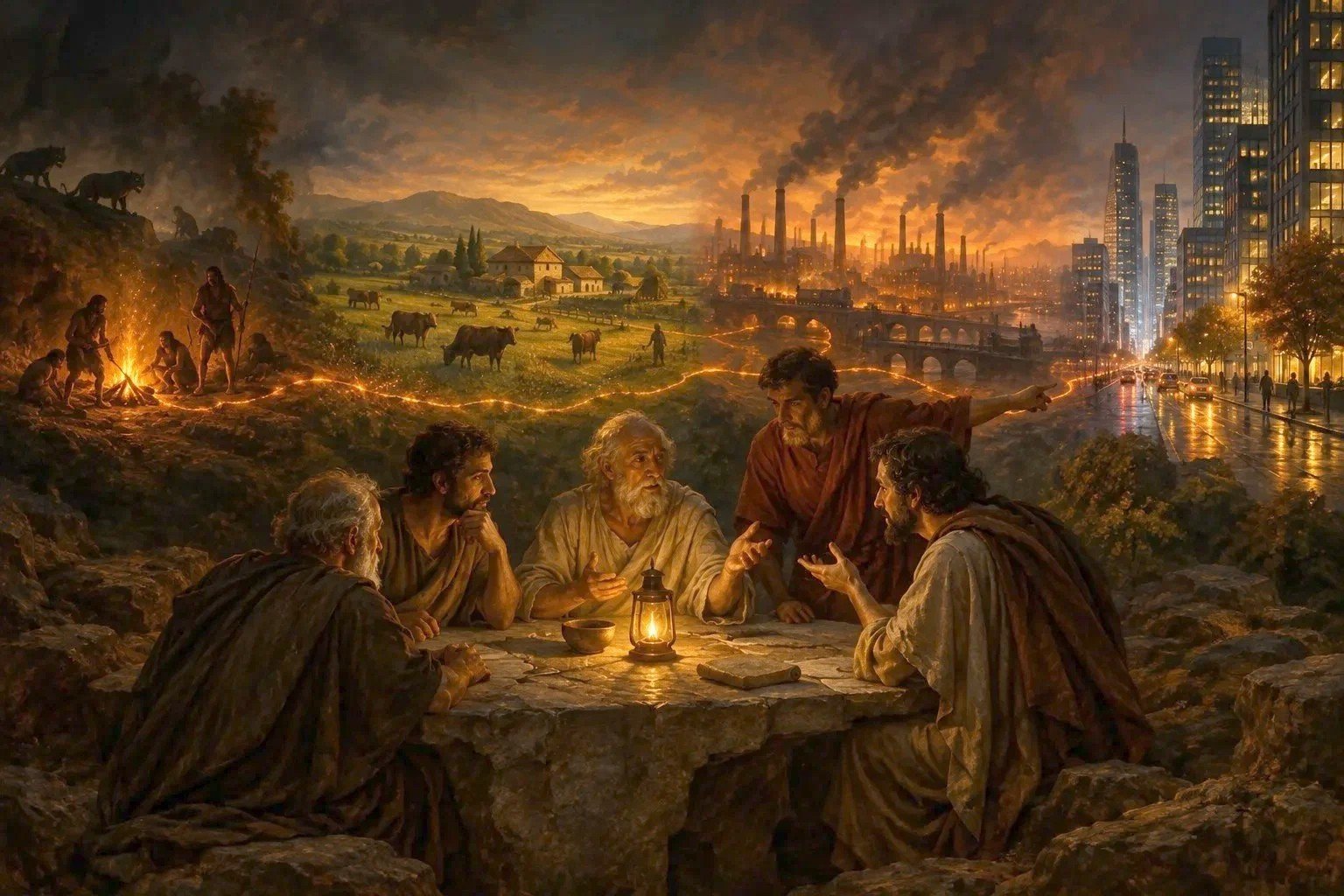
If today is unnatural, perhaps the past offers a baseline. Working backward complicates that hope. In nineteenth-century Britain, the largest industrial cities suffered severe mortality in the 1830s and 1840s, and life expectancy at birth in those cities rose above 40 years only in the final decades of the century.7 Since 1840, record life expectancy has climbed by almost three months each year.8 Was that rise progress beyond our nature, or recovery from lives cut unnaturally short?
Before industry, in the first stage of the epidemiological transition, which Omran called the age of pestilence and famine, life expectancy at birth fluctuated between 20 and 40 years.9 Many major human infections arose only after agriculture, often as zoonotic diseases passing from domestic animals.10 Further back, a cross-cultural study of hunter-gatherer longevity concluded that long post-reproductive life is an evolved human trait, and proposed an adaptive lifespan of 68 to 78 years.11 Low averages in any era reflect deaths in childhood as much as in adulthood, so life expectancy at birth and adult lifespan answer different questions. Did predators, conflict or exclusion from the group keep many from that span, and if so, was their lifespan natural? And does ancestral health, living as our ancestors did, offer a route back?
| Era | What shortened lives | The question it raises |
|---|---|---|
| Today | Degenerative and man-made diseases | Are built environments the new threat? |
| Industrial city | Severe urban mortality, 1830s to 1840s | Was the later rise recovery, not progress? |
| Early farming | Infections passed from domestic animals | Is this when we became unnatural? |
| Paleolithic | Hazards such as predators and conflict (open question) | Is a lifespan the environment limits natural? |
Every era carried its own threats, so the past offers no clean baseline for natural aging.
Back to Today: Can Healthspan Reach a Natural Limit?
If no era clearly lived to its potential, is a natural lifespan something we once had, something we could reach, or something we cannot define? The evidence pulls both ways. One analysis found that survival gains slow after age 100 and that the maximum age at death has not risen since the 1990s.12 Yet life expectancy has broken past predicted ceilings, on average five years after their publication.8 Recent trends show gains slowing in the longest-lived nations.1 Does extending healthspan move us toward a natural limit, or redefine where that limit lies?
Whether healthspan approaches or redefines natural aging remains an open question.
What Medicine Can Learn From Natural Philosophy
Science began as natural philosophy. Thales of Miletus and the Milesian thinkers separated the observation of nature from speculation, and medicine followed, moving from divine to rational explanation.13 Through Pythagoras, Socrates and Plato, that inquiry passed to Aristotle, who held that we do not know a thing until we grasp its why, its cause.14 Hippocratic medicine then asked how air, water and place shape the diseases of a city.13
Centuries later, the biomedical model came to dominate, and critics argued that it left out the social, psychological and behavioral sides of illness.15 Today, reductionism pervades medicine, and researchers propose systems approaches to complement it.16 So when did medicine stop asking why and start solving one problem at a time? Are today’s targeted fixes solving problems naturally, in the old sense of understanding the whole?
| Approach | The question it asked |
|---|---|
| Milesian natural philosophy | What is nature, once observed rather than imagined? |
| Hippocratic medicine | How do air, water and place shape disease? |
| Biomedical model | Which mechanism causes this disease? |
| Systems approaches | How do the parts interact as a whole? |
Whole-system questions came first in medicine; narrow fixes came later.
Questions We Cannot Yet Answer
Some questions in this debate resist an answer. What is the genetic ceiling on human lifespan, when genes are never expressed outside an environment? Does any human era count as a natural baseline? Can we separate genetic potential from environment at all, given gene-environment interaction and genes that evolved within those environments? And when, exactly, did medicine move from asking why to targeting specific problems?
Healthspan and natural aging overlap, but they are not the same thing, because each rests on a definition of “natural” that we rarely state. Before calling anything “natural”, ask which meaning you mean; then ask the older question: when did medicine stop asking why?
The biomedical model “leaves no room … for the social, psychological, and behavioral dimensions of illness.”15
George L. Engel, Science, 1977
References
- Olshansky SJ, Willcox BJ, Demetrius L, Beltrán-Sánchez H. Implausibility of radical life extension in humans in the twenty-first century. Nat Aging. 2024;4(11):1635-42. doi:10.1038/s43587-024-00702-3
- Siipi H. Dimensions of naturalness. Ethics Environ. 2008;13(1):71-103. muse.jhu.edu/article/253438
- Boorse C. Health as a theoretical concept. Philos Sci. 1977;44(4):542-73. cambridge.org (Philosophy of Science)
- Kaeberlein M. How healthy is the healthspan concept? GeroScience. 2018;40(4):361-4. doi:10.1007/s11357-018-0036-9
- Eaton SB, Konner M, Shostak M. Stone agers in the fast lane: chronic degenerative diseases in evolutionary perspective. Am J Med. 1988;84(4):739-49. doi:10.1016/0002-9343(88)90113-1
- Higgins S, Pomeroy A, Bates LC, Paterson C, Barone Gibbs B, Pontzer H, Stoner L. Sedentary behavior and cardiovascular disease risk: an evolutionary perspective. Front Physiol. 2022;13:962791. doi:10.3389/fphys.2022.962791
- Szreter S, Mooney G. Urbanization, mortality, and the standard of living debate: new estimates of the expectation of life at birth in nineteenth-century British cities. Econ Hist Rev. 1998;51(1):84-112. doi:10.1111/1468-0289.00084
- Oeppen J, Vaupel JW. Broken limits to life expectancy. Science. 2002;296(5570):1029-31. doi:10.1126/science.1069675
- Omran AR. The epidemiologic transition: a theory of the epidemiology of population change. 1971. Milbank Q. 2005;83(4):731-57. doi:10.1111/j.1468-0009.2005.00398.x
- Wolfe ND, Dunavan CP, Diamond J. Origins of major human infectious diseases. Nature. 2007;447(7142):279-83. doi:10.1038/nature05775
- Gurven M, Kaplan H. Longevity among hunter-gatherers: a cross-cultural examination. Popul Dev Rev. 2007;33(2):321-65. doi:10.1111/j.1728-4457.2007.00171.x
- Dong X, Milholland B, Vijg J. Evidence for a limit to human lifespan. Nature. 2016;538(7624):257-9. doi:10.1038/nature19793
- Angeletti LR. [Environment and political institutions between antiquity and contemporary medicine]. Med Secoli. 1995;7(3):415-23. Italian. PMID: 11623477
- Falcon A. Aristotle on causality. In: Stanford Encyclopedia of Philosophy. Stanford (CA): Stanford University; 2006 (revised 2023). plato.stanford.edu/entries/aristotle-causality
- Engel GL. The need for a new medical model: a challenge for biomedicine. Science. 1977;196(4286):129-36. doi:10.1126/science.847460
- Ahn AC, Tewari M, Poon CS, Phillips RS. The limits of reductionism in medicine: could systems biology offer an alternative? PLoS Med. 2006;3(6):e208. doi:10.1371/journal.pmed.0030208
Useful Resources
- Concepts of Disease and Health (Stanford Encyclopedia of Philosophy): A philosophical guide to whether health and disease are biological facts or value judgments.
- Greek Medicine (US National Library of Medicine): An exhibition on how classical Greek medicine moved from mystical beliefs to observation.
- FastStats: Life Expectancy (CDC, National Center for Health Statistics): Current US life expectancy figures from national vital statistics.
- The Rise of Maximum Life Expectancy (Our World in Data): Charts showing how predicted limits to life expectancy have repeatedly been passed.
FAQs
What is healthspan?
Healthspan is the part of life spent in good health, as distinct from lifespan, the total years lived. The healthspan vs lifespan distinction asks how long we live well, not only how long we live, and researchers still debate how to measure it, as Kaeberlein’s commentary sets out.
How does life expectancy differ from lifespan?
Life expectancy at birth averages deaths at every age, so high child mortality pulls it down sharply. Lifespan describes how long individuals live; the CDC life expectancy figures show the population measure.
What is evolutionary mismatch?
It is the gap between the conditions our genes were selected for and the environments we now live in. Our evolutionary perspective on sitting applies the idea to sedentary behavior.
Is there a fixed limit to human lifespan?
Researchers disagree. One analysis argues for a fixed maximum, while Our World in Data charts how predicted limits keep being passed.
Is natural always healthier?
Not necessarily. Whether “natural” is better depends on which meaning is in play, and philosophers judge naturalness in several ways. Assuming that natural means good is known as the appeal to nature.


Leave a Reply