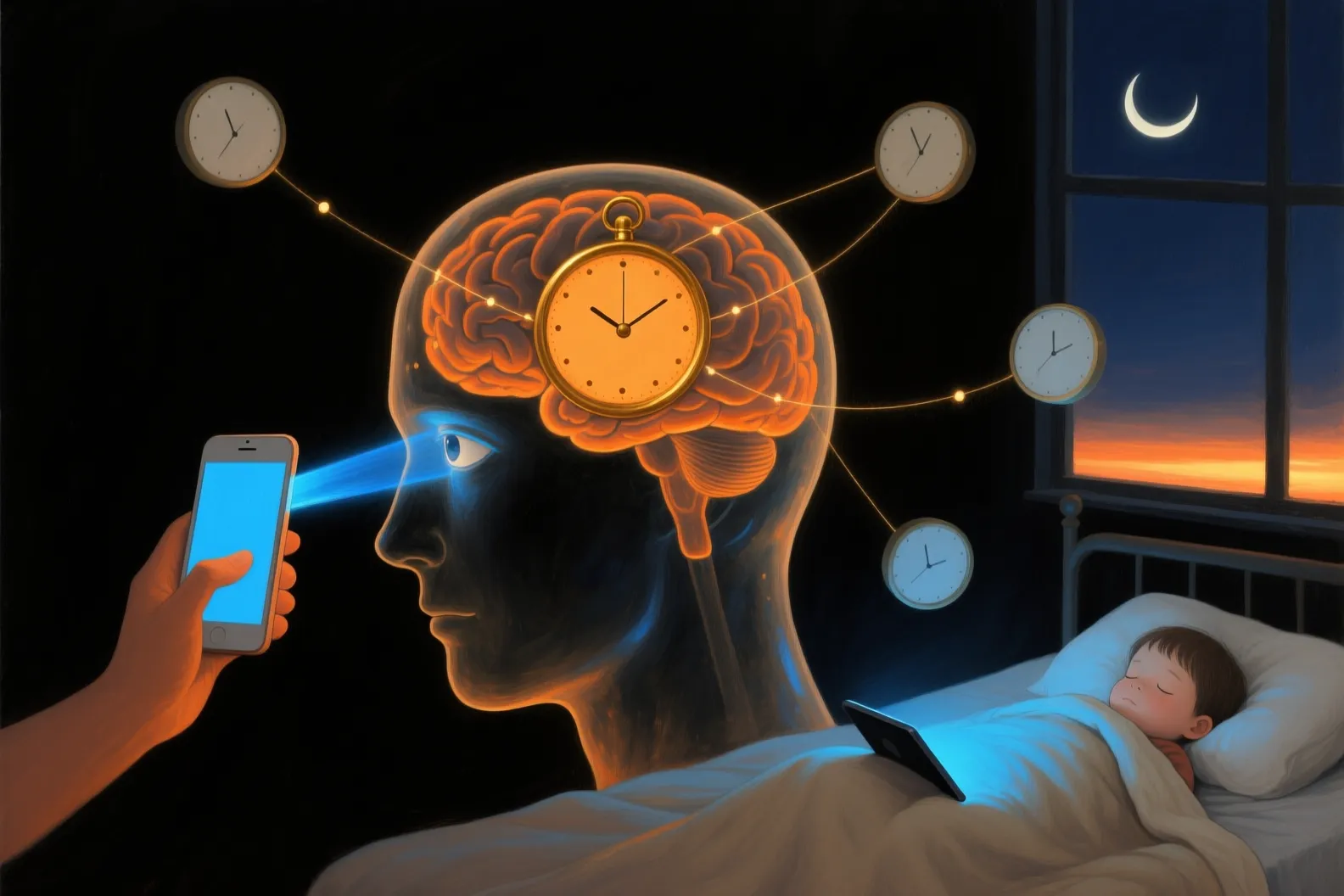
Blue light from your phone does more than brighten the screen: it also tells a tiny clock in your brain what time it is.
That matters, because so many of us read, scroll, or watch in the hour before bed. In one survey of 1,508 American adults, 90% used electronics within an hour of bedtime at least a few nights a week.1 So if your evening ends with a screen, your brain may think the day is still going.
Blue light in the evening reaches your brain’s master clock, with effects that run from tonight’s sleep to your long-term health.
| What you will learn | What you can do with it |
|---|---|
| How light sets your body clock | See why a screen at night differs from sun in the morning |
| What screens do to sleep | Judge whether fixes such as night mode really help |
| Whether blue light harms your eyes | Tell eye strain apart from eye damage |
| Why children are more sensitive | Set evening screen limits that fit the evidence |
How Blue Light Resets Your Circadian Rhythm
Your circadian rhythm is the roughly 24-hour cycle that times your sleep, hormones, and body temperature. In 2017, three scientists won the Nobel Prize in Physiology or Medicine for showing, in fruit flies, how a gene’s protein builds up and breaks down each day to keep time. Similar clocks run in tissues throughout your body, and a master clock in the brain, the suprachiasmatic nucleus (SCN), keeps these peripheral clocks in step.2
Think of the SCN as an orchestra’s conductor and your organs as the players. Light is the conductor’s key cue, and blue light from a screen in the evening can push the beat later.1 Every player then follows a conductor who is running late.
Blue light at night acts as a late cue, and your whole body’s timing follows it.
Screens, Melatonin, and Sleep: What the Trials Show
Melatonin is the hormone your brain releases as darkness falls, a chemical note that night has begun. In a sleep-lab trial, adults who read on a glowing e-reader before bed made less melatonin, fell asleep later, and felt less alert the next morning than after reading a printed book.1
Can night mode fix this? One trial randomly assigned 167 young adults to three groups: an iPhone with Night Shift on, an iPhone with it off, or no phone before bed. Sleep quality did not differ between the groups.3 Light during sleep matters too, since one night in a moderately lit room raised next-morning insulin resistance, a weaker response to the hormone that clears sugar from the blood, compared with a dark room.4
| Finding | Type of study | What it can and cannot show |
|---|---|---|
| A glowing e-reader delayed melatonin, sleep, and the body clock | Controlled sleep-lab trial in adults | Shows cause in a lab; homes may differ |
| Night Shift did not change sleep | Randomized trial, 167 young adults, 7 nights | Shows the color filter alone did not help this group |
| A lit room during sleep raised insulin resistance | Controlled lab trial, one night | Shows a short-term effect; long-term risk was not tested |
In the trial, a warmer screen did not improve sleep, so don’t count on night mode alone.
Blue Light and Your Eyes: Strain Yes, Damage No
Tired, dry, or blurry eyes after hours on screens are common, and digital eye strain may affect 50% or more of computer users.5 It comes from focusing up close and from dry eyes, and it usually passes.5
A 2023 review found no evidence that screen blue light at normal levels harms the retina, or that blue-blocking lenses prevent macular degeneration, a disease that blurs central vision.6 The effects of decades of exposure, however, are still unknown.6
| Eye claim | What the evidence says | Source |
|---|---|---|
| Screens cause eye strain | Common and usually temporary | Sheppard 2018 (ref 5) |
| Screen blue light damages the retina | No evidence at normal use | Cougnard-Gregoire 2023 (ref 6) |
| Blue-blocking glasses prevent macular degeneration | No evidence of benefit | Cougnard-Gregoire 2023 (ref 6) |
| Decades of exposure are safe | Not yet known | Cougnard-Gregoire 2023 (ref 6) |
Rest tired eyes, but no study has shown that screen blue light at normal levels harms them.
Children’s Sleep and Long-Term Health
Children may feel blue light in the evening more strongly than adults. In one small study, melatonin suppression under bright light at night reached 88% in children and 46% in adults.7
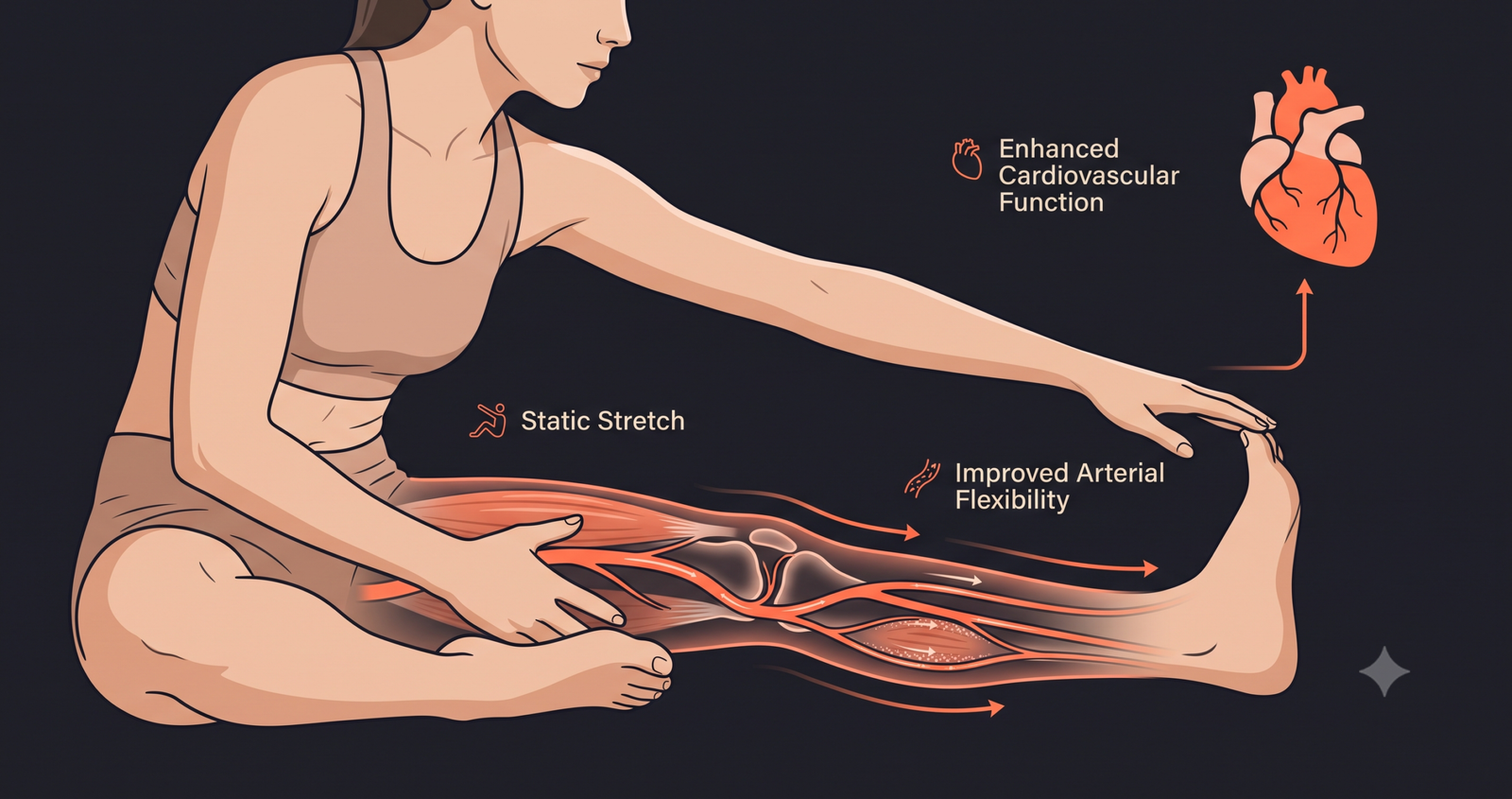
Among 332 children aged 8 to 10, social jetlag, the gap between school-day and weekend sleep timing, went with blood-vessel health and cholesterol, but sleep length did not.8 In adults, short and long sleep both went with stiffer arteries, and irregular sleep went with higher blood pressure.9,10 These are links, not proof that screens cause harm.
Children’s clocks respond strongly to evening light, so their limits matter too.
Takeaway
Blue light is a time signal first. It reaches your master clock, shifts your circadian rhythm, and delays sleep, while claims that screens damage your eyes find no support at normal use.1,2,6 So protect your evenings: dim the lights, cut screen time before bed, and give children the same limits.
“Currently, there is no evidence that LEDs [light-emitting diodes] in normal use at domestic intensity levels or in screen devices are retinotoxic to the human eye.”
Cougnard-Gregoire and colleagues, Ophthalmology and Therapy, 2023.6
References
- Chang AM, Aeschbach D, Duffy JF, Czeisler CA. Evening use of light-emitting eReaders negatively affects sleep, circadian timing, and next-morning alertness. Proc Natl Acad Sci U S A. 2014;112(4):1232-7. doi: 10.1073/pnas.1418490112
- Patke A, Young MW, Axelrod S. Molecular mechanisms and physiological importance of circadian rhythms. Nat Rev Mol Cell Biol. 2019;21(2):67-84. doi: 10.1038/s41580-019-0179-2
- Duraccio KM, Zaugg KK, Blackburn RC, Jensen CD. Does iPhone night shift mitigate negative effects of smartphone use on sleep outcomes in emerging adults? Sleep Health. 2021;7(4):478-84. doi: 10.1016/j.sleh.2021.03.005
- Mason IC, Grimaldi D, Reid KJ, Warlick CD, Malkani RG, Abbott SM, et al. Light exposure during sleep impairs cardiometabolic function. Proc Natl Acad Sci U S A. 2022;119(12):e2113290119. doi: 10.1073/pnas.2113290119
- Sheppard AL, Wolffsohn JS. Digital eye strain: prevalence, measurement and amelioration. BMJ Open Ophthalmol. 2018;3(1):e000146. doi: 10.1136/bmjophth-2018-000146
- Cougnard-Gregoire A, Merle BMJ, Aslam T, Seddon JM, Aknin I, Klaver CCW, et al. Blue light exposure: ocular hazards and prevention-a narrative review. Ophthalmol Ther. 2023;12(2):755-88. doi: 10.1007/s40123-023-00675-3
- Higuchi S, Nagafuchi Y, Lee SI, Harada T. Influence of light at night on melatonin suppression in children. J Clin Endocrinol Metab. 2014;99(9):3298-303. doi: 10.1210/jc.2014-1629
- Castro N, Diana J, Blackwell J, Faulkner J, Lark S, Skidmore P, et al. Social jetlag and cardiometabolic risk in preadolescent children. Front Cardiovasc Med. 2021;8:705169. doi: 10.3389/fcvm.2021.705169
- Pomeroy A, Pagan Lassalle P, Kline CE, Heffernan KS, Meyer ML, Stoner L. The relationship between sleep duration and arterial stiffness: a meta-analysis. Sleep Med Rev. 2023;70:101794. doi: 10.1016/j.smrv.2023.101794
- Culver MN, McMillan NK, Cross BL, Robinson AT, Montoye AH, Riemann BL, et al. Sleep duration irregularity is associated with elevated blood pressure in young adults. Chronobiol Int. 2022;39(10):1320-8. doi: 10.1080/07420528.2022.2101373
Useful Resources
- The Nobel Prize: 2017 press release: The Nobel Assembly’s announcement of the prize for discovering how the circadian clock works.
- NIGMS: Circadian Rhythms: A fact sheet on body clocks from the US National Institute of General Medical Sciences.
- CDC: Tips for Better Sleep: Sleep habits from the US Centers for Disease Control and Prevention.
- Prevent Blindness: Blue Light fact sheet: A fact sheet on blue light and digital devices from the eye health charity Prevent Blindness.
FAQs
Does night mode stop blue light from affecting sleep?
Not on its own. In a randomized trial, young adults who used Night Shift before bed slept no better than those who left it off.
Do blue-light glasses protect my eyes?
No study has shown that blue-blocking lenses prevent eye disease such as macular degeneration, according to a 2023 review. For tired eyes, this eye strain review lists regular screen breaks among the options.
Can screens cause macular degeneration?
No study has shown that blue light from screens at normal levels harms the human retina, although this review notes that the effects of decades of exposure are still unknown.
Are children more sensitive to light at night?
Likely, going by one small study in which bright light at night lowered children’s melatonin almost twice as much as adults’. The NIGMS circadian rhythms fact sheet from the National Institute of General Medical Sciences offers background.
Why do my eyes feel tired after using screens?
Focusing up close for long periods and dry eyes cause most of the strain. Screen breaks, dry-eye care, and correcting any vision problem help, according to this review.

Leave a Reply