By Dr. Lee Stoner
Introduction
Sleep and depression travel together: in a US national survey, 92% of adults in a depressive episode reported sleep complaints.1 Poor sleep is part of depression, yet long-term studies find it turning up years before depression begins.2 That leaves a puzzle: is poor sleep an early warning of depression, a cause, or a result? Table 1 sets out how this post answers.
| What you will learn | Why it matters |
|---|---|
| What good sleep is, and the ways it falls short | Poor sleep means more than too little sleep |
| How poor sleep can come before depression | One direction of the link |
| How depression changes sleep | The other direction |
| What different kinds of study can show | Judging claims about cause |
| One step you can take | Supporting good sleep |
To answer it, this post follows the evidence both ways, building on our earlier post on physical activity and antidepressants. Depression here means the condition doctors diagnose, or its symptoms on standard questionnaires, not a passing low mood. Studies in both directions suggest that sleep and depression feed each other.
What Good Sleep and Poor Sleep Look Like
Sleep researcher Daniel Buysse describes good sleep, or sleep health, as a pattern of sleeping and waking that supports body and mind.3 It has five parts, set out in Figure 1. Poor sleep falls short on any part: broken nights, a late or shifting bedtime, or sleepy afternoons all count.
Length is the easiest part to measure: adults need 7 or more hours a night, but whether regularly sleeping more than 9 hours is healthy is unclear.4 Long sleep may not be harmless, though: across 11 studies of more than 100,000 adults, short and long sleep both went with stiffer arteries, a marker of heart disease risk.5 So too much sleep, not only too little, counts as poor sleep.
Poor sleep can be too short, too long, badly timed, broken, or unsatisfying.
When Poor Sleep Comes Before Depression
The clearest test of order follows people free of depression to see who develops it. Combining seven such studies, researchers found a higher risk of later depression in both short and long sleepers.6 Insomnia showed the strongest link: across 34 studies and 172,077 people, those with insomnia, compared with those without, had more than twice the risk of later depression (Table 2).2
| Kind of poor sleep | Link with depression | Evidence |
|---|---|---|
| Short sleep | RR 1.31 (1.04 to 1.64) | 7 follow-up studies, 25,271 people |
| Long sleep | RR 1.42 (1.04 to 1.92) | 7 follow-up studies, 23,663 people |
| Insomnia | RR 2.27 (1.89 to 2.71) | 34 follow-up studies, 172,077 people |
| Irregular timing | Steadier sleep and wake times went with less depression | 181,574 sleep-tracker users |
Follow-up studies like these cannot prove that poor sleep causes depression, because early, unnoticed changes in mood may already be disturbing sleep. Either way, poor sleep that comes first is worth noticing: it marked out people likelier to develop depression.
Short sleep, long sleep, and insomnia come before depression; cause is not settled.
When Depression Changes Sleep
If poor sleep can come before depression, can depression also change sleep? In the same survey of 3,573 adults in a depressive episode, 48.5% had insomnia symptoms only, 13.7% overslept only, and 30.2% had both (Figure 2).1 Together, they make up the 92%.1
Tracker data add a view within each person: across 181,574 people, months of longer sleep tended to be months of higher depression scores.7 So depression does not only take sleep away; for more than four in ten in an episode, it comes with sleeping too much.1
During depression, sleep can be too little, broken, or too much.
How Sleep and Depression Feed Each Other
Follow-up studies show order, not cause, so other designs test each direction (Table 3). A genetic study found that genes linked to insomnia raised the risk of depression, and genes linked to depression raised the risk of insomnia.8
| Kind of study | What it can show | What it cannot show |
|---|---|---|
| Follow-up studies | Which comes first in time | Whether one causes the other |
| Genetic studies | Possible effects in each direction | How much changing a sleep habit would help |
| Trials | Whether improving sleep lowers depression | Whether results hold beyond the groups tested |
Trials go further: across 65 trials with 8,608 people, treatments that improved sleep also eased depression.9 One trial followed 291 adults aged 60 and over with insomnia for up to three years. Depression developed in 12.2% of those given cognitive behavioral therapy for insomnia (CBT-I), a short course that rebuilds sleep habits, against 25.9% given general sleep education.10 Both directions, then, hold up in tests stronger than timing alone.
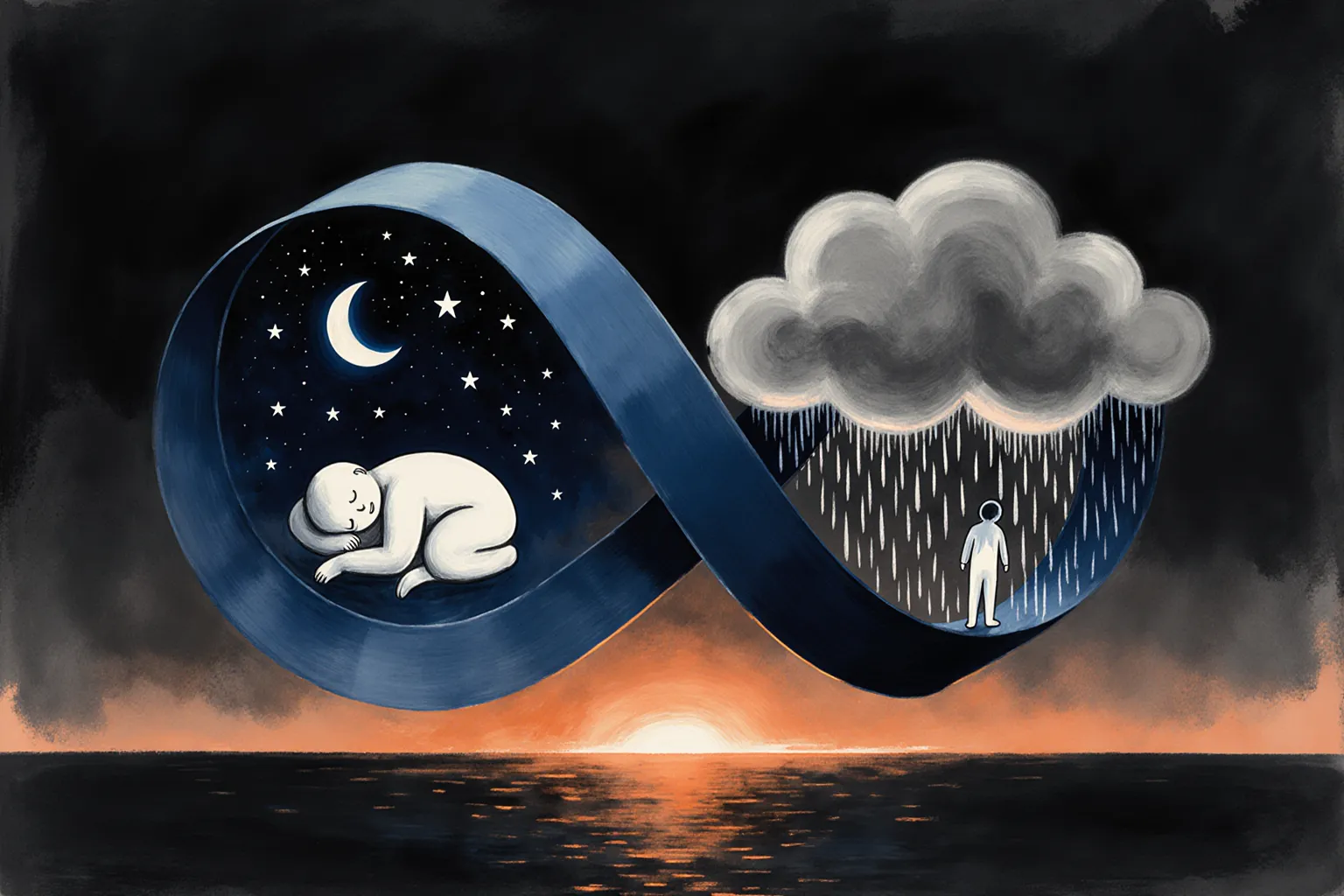
The link between sleep and depression runs both ways.
Takeaway: Sleep and Depression Shape Each Other
With sleep and depression, neither one always comes first. Poor sleep can come before depression as an early warning, depression can reshape sleep, and the two can keep each other going, so a lasting problem with either deserves attention. Whichever way the link runs, a steady wake time supports good sleep. The National Heart, Lung, and Blood Institute advises waking at the same time every day, keeping weekends within about an hour of weekdays.
“Good sleep is essential to good health.”
Daniel Buysse, Sleep, 2014.3
References
- Geoffroy PA, Hoertel N, Etain B, Bellivier F, Delorme R, Limosin F, et al. Insomnia and hypersomnia in major depressive episode: prevalence, sociodemographic characteristics and psychiatric comorbidity in a population-based study. J Affect Disord. 2018;226:132-141. doi:10.1016/j.jad.2017.09.032
- Li L, Wu C, Gan Y, Qu X, Lu Z. Insomnia and the risk of depression: a meta-analysis of prospective cohort studies. BMC Psychiatry. 2016;16(1):375. doi:10.1186/s12888-016-1075-3
- Buysse DJ. Sleep health: can we define it? Does it matter? Sleep. 2014;37(1):9-17. doi:10.5665/sleep.3298
- Watson NF, Badr MS, Belenky G, Bliwise DL, Buxton OM, Buysse D, et al. Recommended amount of sleep for a healthy adult: a joint consensus statement of the American Academy of Sleep Medicine and Sleep Research Society. Sleep. 2015;38(6):843-844. doi:10.5665/sleep.4716
- Pomeroy A, Pagan Lassalle P, Kline CE, Heffernan KS, Meyer ML, Stoner L. The relationship between sleep duration and arterial stiffness: a meta-analysis. Sleep Med Rev. 2023;70:101794. doi:10.1016/j.smrv.2023.101794
- Zhai L, Zhang H, Zhang D. Sleep duration and depression among adults: a meta-analysis of prospective studies. Depress Anxiety. 2015;32(9):664-670. doi:10.1002/da.22386
- Presby D, Jasinski S, Capodilupo E, Holmes KE, von Hippel W, Grosicki GJ, et al. Inter- and intrapersonal associations between physiology and mental health: a longitudinal study using wearables and mental health surveys. J Med Internet Res. 2025;27:e64955. doi:10.2196/64955
- Sun X, Liu B, Liu S, Wu DJH, Wang J, Qian Y, et al. Sleep disturbance and psychiatric disorders: a bidirectional Mendelian randomisation study. Epidemiol Psychiatr Sci. 2022;31:e26. doi:10.1017/S2045796021000810
- Scott AJ, Webb TL, Martyn-St James M, Rowse G, Weich S. Improving sleep quality leads to better mental health: a meta-analysis of randomised controlled trials. Sleep Med Rev. 2021;60:101556. doi:10.1016/j.smrv.2021.101556
- Irwin MR, Carrillo C, Sadeghi N, Bjurstrom MF, Breen EC, Olmstead R. Prevention of incident and recurrent major depression in older adults with insomnia: a randomized clinical trial. JAMA Psychiatry. 2022;79(1):33-41. doi:10.1001/jamapsychiatry.2021.3422
Related Entries
- Physical Activity vs Antidepressants: The Surprising Results
- How Do Antidepressants Actually Work? The Serotonin Story and Newer Ideas
- Blue Light and the Master Clock in Your Brain
- Meta-Analysis
- Causal Inference
- Chronotype
- Social Jetlag
- Arterial Stiffness
Useful Resources
- Centers for Disease Control and Prevention (CDC): Sleep in Adults: how much sleep adults need, with national figures.
- National Heart, Lung, and Blood Institute (NHLBI): Healthy Sleep Habits: practical habits for a steady sleep schedule.
- NHLBI: Sleep Disorder Treatments: how sleep disorders are treated, including CBT-I.
- National Institute of Mental Health (NIMH): Depression: what depression is and how it is treated.
FAQs
How much sleep do adults need?
Adults need at least 7 hours a night, according to the Centers for Disease Control and Prevention. Whether regularly sleeping more than 9 hours is healthy is less clear.4
Is oversleeping a sign of depression?
It can be. More than four in ten adults in a depressive episode report oversleeping,1 and long sleep also comes before new depression.6 The National Institute of Mental Health explains how doctors diagnose depression.
Will fixing my sleep fix my mood?
Better sleep may help. Trials that improved sleep also eased depression,9 and depression has its own treatments, from antidepressants to talking therapy.
Which comes first, poor sleep or depression?
Either can. Follow-up studies show poor sleep often comes first, while genetic studies show depression also raises the risk of insomnia.2,8 Our causal inference entry explains why order alone cannot prove cause.
Can a sleep tracker tell if I am depressed?
Not yet. Tracker users with steadier sleep had lower depression scores, but its authors call for more research before such data can help in care.7 Our chronotype and social jetlag entries explain timing data.
© 2026 SciencEye. All rights reserved. | SciencEye.com



Leave a Reply